Built for Accuracy. Designed for Production.
Minimizing Scrap with Precision Custom Tooling in Hot Stamping
September 17, 2026
In high-volume manufacturing, the profitability of a hot stamping run is intrinsically tied to yield. When applying foils or heat transfers to complex, multi-dimensional polymer substrates, even a millimeter of deviation can result in incomplete foil transfer, distorted graphics, or substrate damage. For manufacturing and quality engineers, achieving sustainable scrap reduction manufacturing requires addressing the root cause of process variation: part instability during the stamping cycle.
The most effective engineering solution lies in utilizing exact, bespoke fixtures to support the substrate.
The Mechanics of Defect Generation in Complex Stamping Runs
Before examining tooling solutions, it is critical to understand how defects physically occur. During a hot stamping cycle, the substrate is subjected to intense heat and mechanical pressure (tonnage). If a part is not fully supported, it will flex, pivot, or shift under the heated die. This dynamic movement leads to several common defects:
- Misregistration: The foil or heat transfer label lands outside the specified tolerance zone.
- Flaking and Voids: Uneven pressure distribution prevents the adhesive layer from properly cross-linking with the substrate, causing the foil to peel or flake.
- Substrate Cracking: Uncontrolled flexing under high pressure can cause micro-fractures, particularly in rigid, brittle plastics.
The Role of Precision Part Nesting
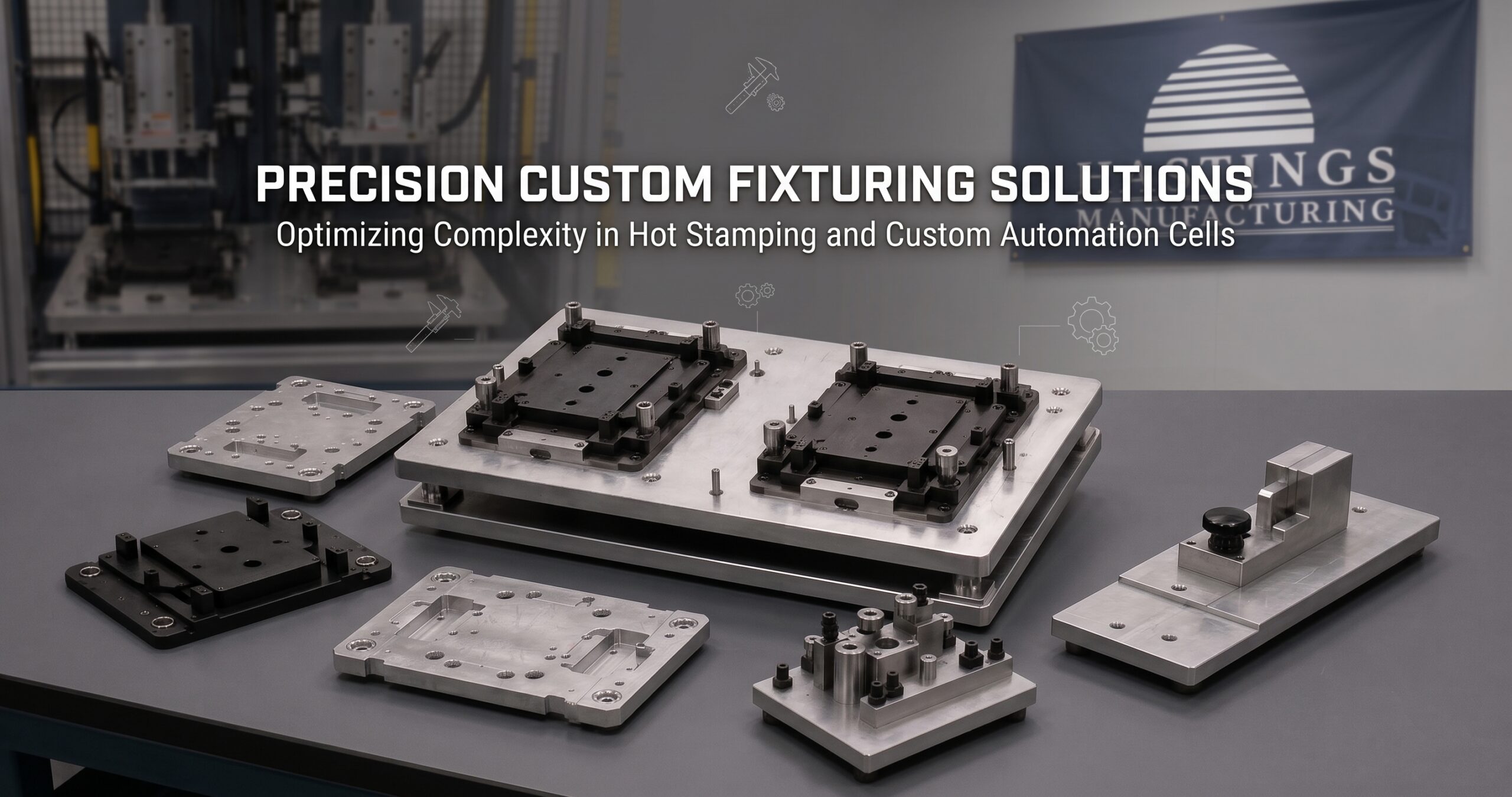
The antidote to part shift and flex is precision part nesting. This engineering process involves creating a custom cradle—or “nest”—that perfectly mirrors the 3D geometry of the target component. By continuously supporting the underside and securely locking the perimeter of the part, precision part nesting ensures that all applied press tonnage is transferred directly into the foil layer rather than dissipating into substrate deflection.
For complex geometries, such as cylindrical components, contoured automotive trim, or multi-faceted appliance housings, standard flat anvils are vastly insufficient. A precisely engineered nest immobilizes the part, standardizing the presentation angle to the heated die across thousands of cycles. This mechanical repeatability is the cornerstone of tight-tolerance production.
Developing Custom Hot Stamping Tooling for Maximum Stability
Implementing these precise nests requires investing in high-quality custom hot stamping tooling. Tooling engineers must account for the specific material properties of the substrate, the thermal dynamics of the die, and the mechanical sequence of the press itself. Custom fixtures are generally CNC-machined from aluminum, steel, or specialized high-temperature urethanes that provide both rigid support and the slight compliance necessary to absorb minor dimensional variations in molded parts.
At Hastings Manufacturing, we understand that off-the-shelf solutions rarely meet the strict demands of advanced production lines. By integrating custom-machined anvils and holding fixtures directly into your automation cell, you eliminate human loading errors and fully stabilize the stamping environment. You can explore our complete range of bespoke engineering capabilities on our Tooling & Fixtures page.
Aligning with Lean Manufacturing Principles
Reducing scrap isn’t just about saving material; it is about protecting machine time and optimizing your line’s Overall Equipment Effectiveness (OEE). By eliminating the root causes of misprints, engineers can bring their hot stamping cells into compliance with advanced continuous improvement frameworks. As detailed in the Lean Enterprise Institute’s guidelines on defect reduction, true waste elimination requires building quality directly into the process via robust fixture design and error-proofing (poka-yoke), rather than relying on costly post-process inspection.
Next Steps for Quality and Manufacturing Engineers
If your facility is battling high reject rates on complex decorating runs, the problem likely isn’t your press or your foil—it is your tooling. Upgrading to a custom-machined nest will lock your process into a repeatable, high-yield cycle.
Ready to eliminate scrap and optimize your hot stamping process?
Our engineering team is prepared to analyze your component geometry and design a specialized fixture that guarantees perfect registration. Submit your concepts to our team today to request a quote for a custom tooling solution, and let Hastings Manufacturing build stability directly into your production line.