Built for Accuracy. Designed for Production.

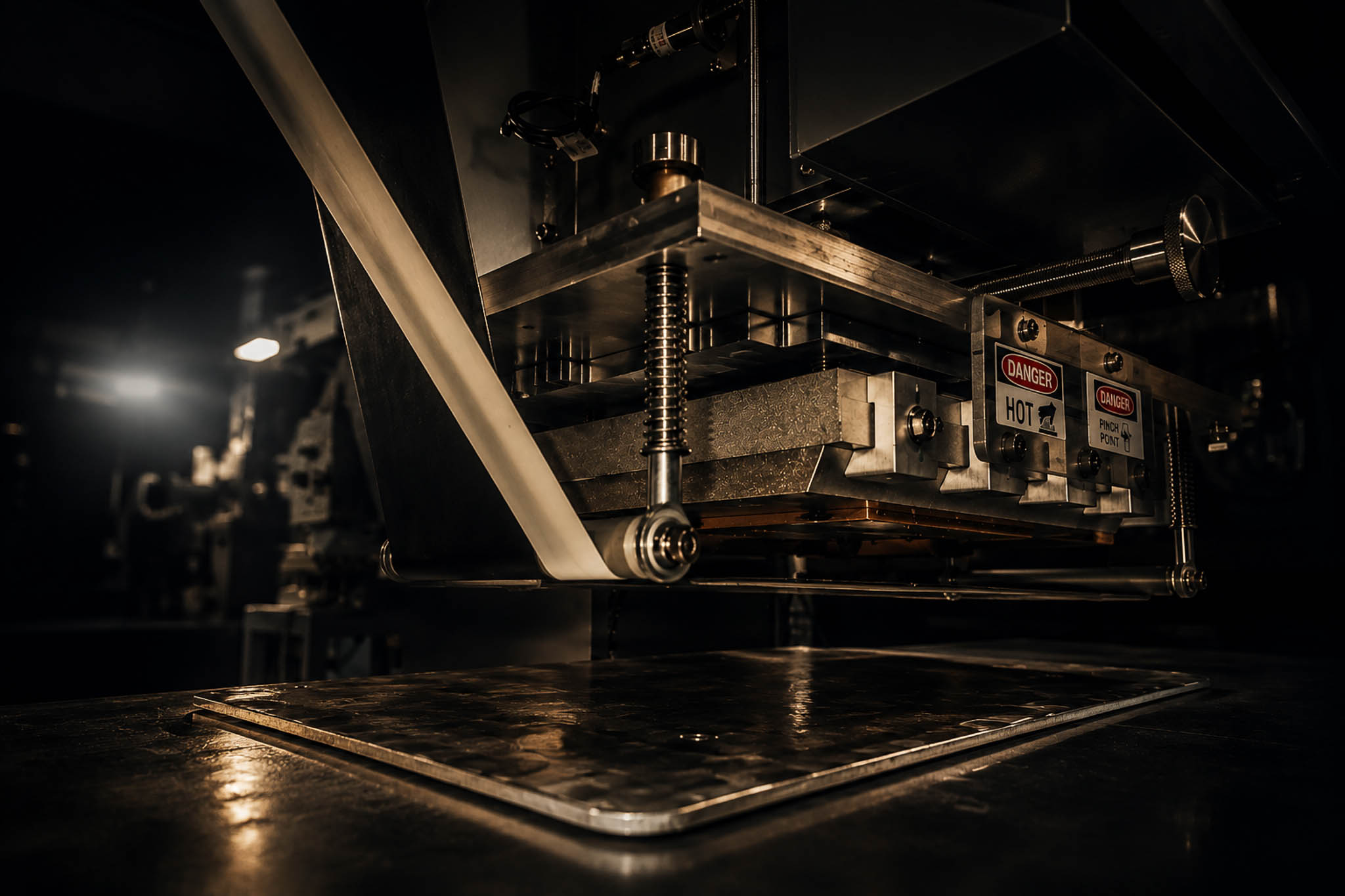
Hot stamping
Hot Stamping
Durable Foil-Based Marking for Industrial Applications
Hot stamping is a decorating and marking process that uses heat, pressure, and precision timing to transfer a foil image onto a part surface. This process is widely used for durable, high-quality markings across a range of materials and industries.
The foil is carried on a film and transferred to the part using a heated die, creating a clean, consistent imprint.
How Hot Stamping Works
The process involves:
- A heated die with imprint mark is brought into contact with the foil
- Pressure is applied to transfer the image
- The foil releases from the carrier and adheres to the part surface
- The carrier film advances to the next position
This process produces a consistent and repeatable result with minimal setup complexity.
Key
Benefits
Durable markings with strong adhesion
Consistent image quality across production runs
Suitable for metallic and high-contrast finishes
Efficient process with relatively simple indexing
Reliable performance in high-volume environments
Material
Compatibility
Plastics
Rubber
Paper and packaging materials
Coated surfaces
Some textiles
Process Considerations
Hot stamping is best suited for applications where:
- Single-color or metallic finishes are required
- Durability and adhesion are critical
- The part surface is relatively consistent
- Simplicity and repeatability are important
Typical Applications
- Product branding and logos
- Identification marks
- Decorative finishes on consumer products
- Packaging and labeling
- Industrial component marking
Equipment Compatibility
Hot stamping can be performed on:
- Pneumatic presses (P Series)
- Hydra-pneumatic presses (HP Series)
- Hydraulic presses (H Series)
- Multi-head systems
All Hastings presses can be configured for hot stamping applications.