Built for Accuracy. Designed for Production.
Total Cost of Ownership: Analyzing Air Consumption in Pneumatic vs. Hydra-Pneumatic Presses
September 17, 2026
When evaluating capital equipment for high-volume manufacturing, procurement teams and operations directors often focus heavily on the initial purchase price. However, in the realm of industrial press technology, the sticker price represents only a fraction of the financial picture. To accurately assess the total cost of ownership industrial presses command over their lifecycle, facility leaders must look directly at operational expenditures (OPEX)—with compressed air generation being the most critical and often overlooked factor.
According to the U.S. Department of Energy, compressed air is one of the most expensive utilities in a manufacturing plant, frequently accounting for 10% to 30% of total facility electricity consumption [cite: 1.1.8]. When your production lines run millions of cycles annually, the efficiency of your presses directly dictates the load on your factory’s air compressors.
In this guide, we analyze the long-term financial and operational impacts of standard pneumatic systems versus hydra-pneumatic technology, helping you optimize your facility’s energy footprint and bottom line.
The Hidden Costs of Pneumatic Press Air Consumption
Standard pneumatic presses are a staple in manufacturing due to their simplicity, speed, and reliability. They rely entirely on factory shop air to drive the cylinder downward and apply force. While highly effective for certain applications, this design inherently requires filling the entire volume of the pneumatic cylinder with compressed air to achieve the desired tonnage.
In high-volume facilities, the cumulative effect of pneumatic press air consumption can lead to significant OPEX inflation. Key factors driving these costs include:
- Cylinder Volume vs. Tonnage Requirements: To achieve higher forces, standard pneumatic presses require larger bore cylinders. Filling these massive cylinders with air every single cycle demands a tremendous volume of cubic feet per minute (CFM) from your compressor.
- Compressor Wear and Tear: Continuous high-volume air draw forces facility compressors to run constantly at full load, accelerating mechanical wear and increasing maintenance intervals on the compressors themselves.
- Vulnerability to System Leaks: The DOE estimates that unaddressed leaks can waste as much as 20% to 30% of a compressor’s output [cite: 1.1.7]. Systems relying on massive volumes of high-pressure air are more susceptible to these costly pressure drops.
- Inefficient Force Curves: A standard pneumatic cylinder consumes maximum air volume regardless of whether the tool is engaging the material or simply traveling through free space to reach the workpiece.
Note: For applications demanding strictly lightweight, fast-cycling operations where high tonnage is unnecessary, a well-maintained, properly sized P Series Pneumatic Press remains a highly effective and economical choice.
The Mechanics of Hydra-Pneumatic Energy Efficiency
For facilities that require the high tonnage of a hydraulic system but want to maintain the speed and cleanliness of a pneumatic press, hydra-pneumatic technology offers a sophisticated solution.
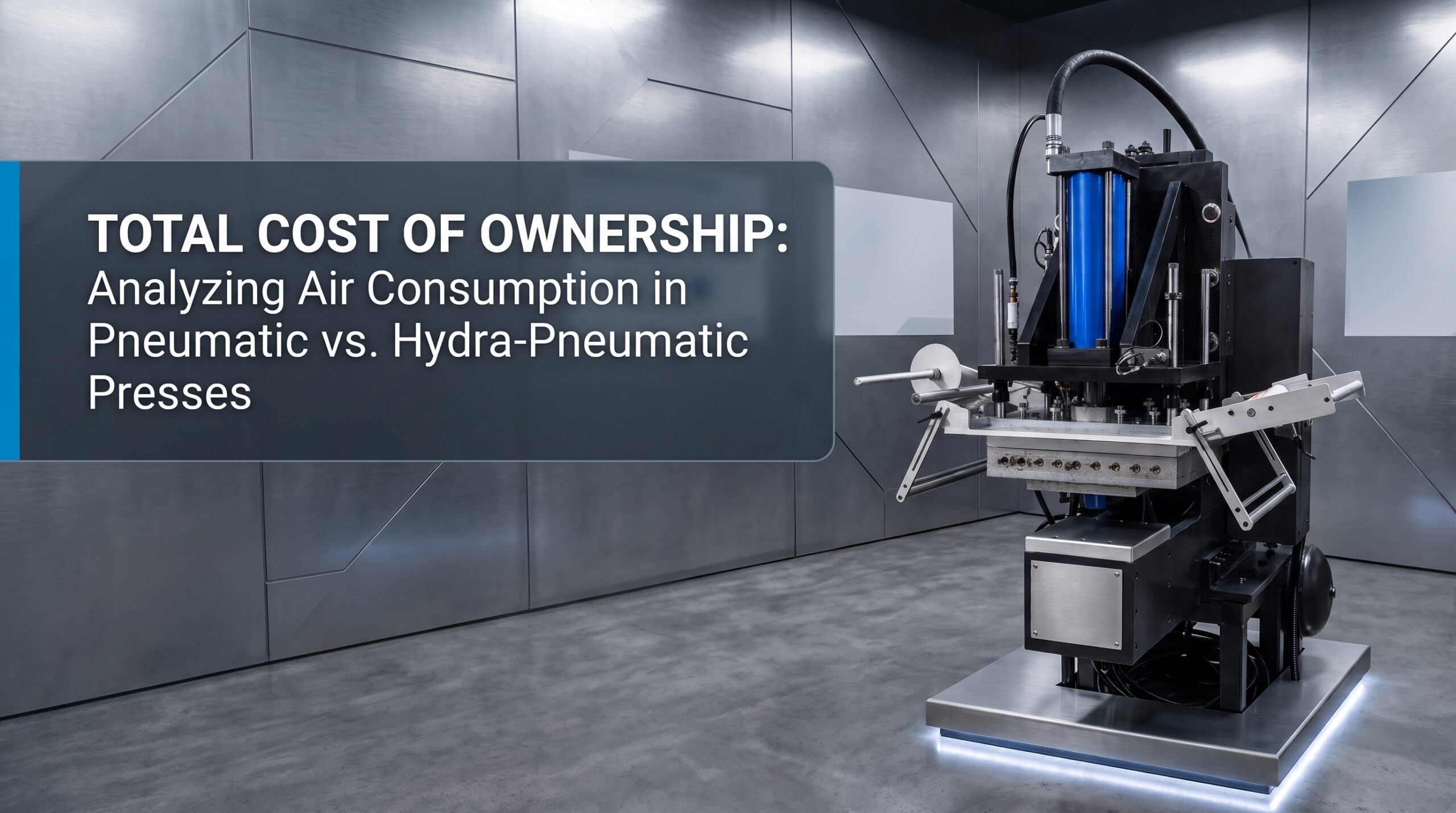
Instead of relying on compressed air to generate maximum force throughout the entire stroke, hydra-pneumatic systems utilize a dual-stage approach. Factory air is only used to rapidly advance the tooling to the workpiece (the approach stroke) and to retract it. Once the tooling makes contact, a self-contained, closed-loop hydraulic intensifier engages to deliver the high-tonnage power stroke.
This hybrid design drives unparalleled hydra-pneumatic energy efficiency. The operational advantages include:
- Drastic CFM Reduction: Because high-pressure air is only used to trigger the hydraulic intensifier rather than fill a massive cylinder, hydra-pneumatic presses consume up to 70% less compressed air per cycle compared to standard pneumatic presses of the same tonnage.
- Targeted Power Delivery: The system only expends peak energy during the actual working portion of the stroke (typically the last fraction of an inch), rather than wasting energy moving tooling through empty space.
- Lower Baseline Compressor Load: By drastically reducing the CFM draw per machine, facilities can often power an entire bank of hydra-pneumatic presses on a smaller compressor, or avoid triggering secondary backup compressors during peak production shifts.
- Elimination of Hydraulic Power Units (HPUs): Unlike traditional hydraulic presses, hydra-pneumatic systems do not require external HPUs, continuous electric pump motors, or massive oil reservoirs, further reducing electrical consumption and maintenance overhead.
To see this technology in action, explore our HP Series Hydra-Pneumatic Presses
to highlight how hydra-pneumatic technology reduces compressor load while delivering exceptional, repeatable high tonnage.
Side-by-Side Comparison: Pneumatic vs. Hydra-Pneumatic
When calculating OPEX, visualizing the performance differences is essential. Below is a comparative breakdown of how these two technologies impact your facility’s long-term operating costs.
| Operational Metric | Standard Pneumatic Press | Hydra-Pneumatic Press |
| Air Consumption per Cycle | Very High (Requires filling full cylinder volume) | Low (Uses up to 70% less air per cycle) |
| Tonnage Capability | Limited (Impractical for high-tonnage needs) | Extremely High (Up to 100+ tons) |
| Energy Efficiency | Moderate | Excellent (Targeted power delivery) |
| Impact on Compressors | Heavy continuous load; exacerbates pressure drops | Minimal load; preserves compressor lifespan |
| Ideal Application | Lightweight, high-speed, fast-cycling assembly | Coining, forming, piercing, high-force assembly |
| Long-Term OPEX | Higher (Driven by electricity for air generation) | Lower (Rapid ROI through energy savings) |
Strategic Capital Equipment Planning
Optimizing your factory’s compressed air system is one of the most effective strategies for reducing your overall carbon footprint and driving down OPEX. For comprehensive guidance on managing your facility’s air generation, we highly recommend reviewing the U.S. Department of Energy’s authoritative sourcebook on Improving Compressed Air System Performance [cite: 1.1.4].
By transitioning high-force applications away from standard pneumatics and adopting hydra-pneumatic technology, procurement teams can shift their focus from the initial capital expenditure to the long-term financial yield. The month-over-month savings in electricity—achieved by eliminating wasted compressed air and reducing compressor duty cycles—can often justify the investment in a hydra-pneumatic system within 12 to 18 months.
Ready to Calculate Your ROI?
Stop letting hidden utility costs drain your operational budget. Don’t guess on your capital equipment ROI—calculate it with precision.
Contact our Sales & Engineering Team to calculate the exact ROI of an HP Series upgrade for your facility. Let Hastings Manufacturing help you engineer a more profitable, energy-efficient future.