Built for Accuracy. Designed for Production.
Silicone vs. Metal Hot Stamping Dies: Selecting the Right Tooling for Complex Part Geometries
September 16, 2026
The Critical Role of Tooling in Scrap Reduction and Cost-Efficiency
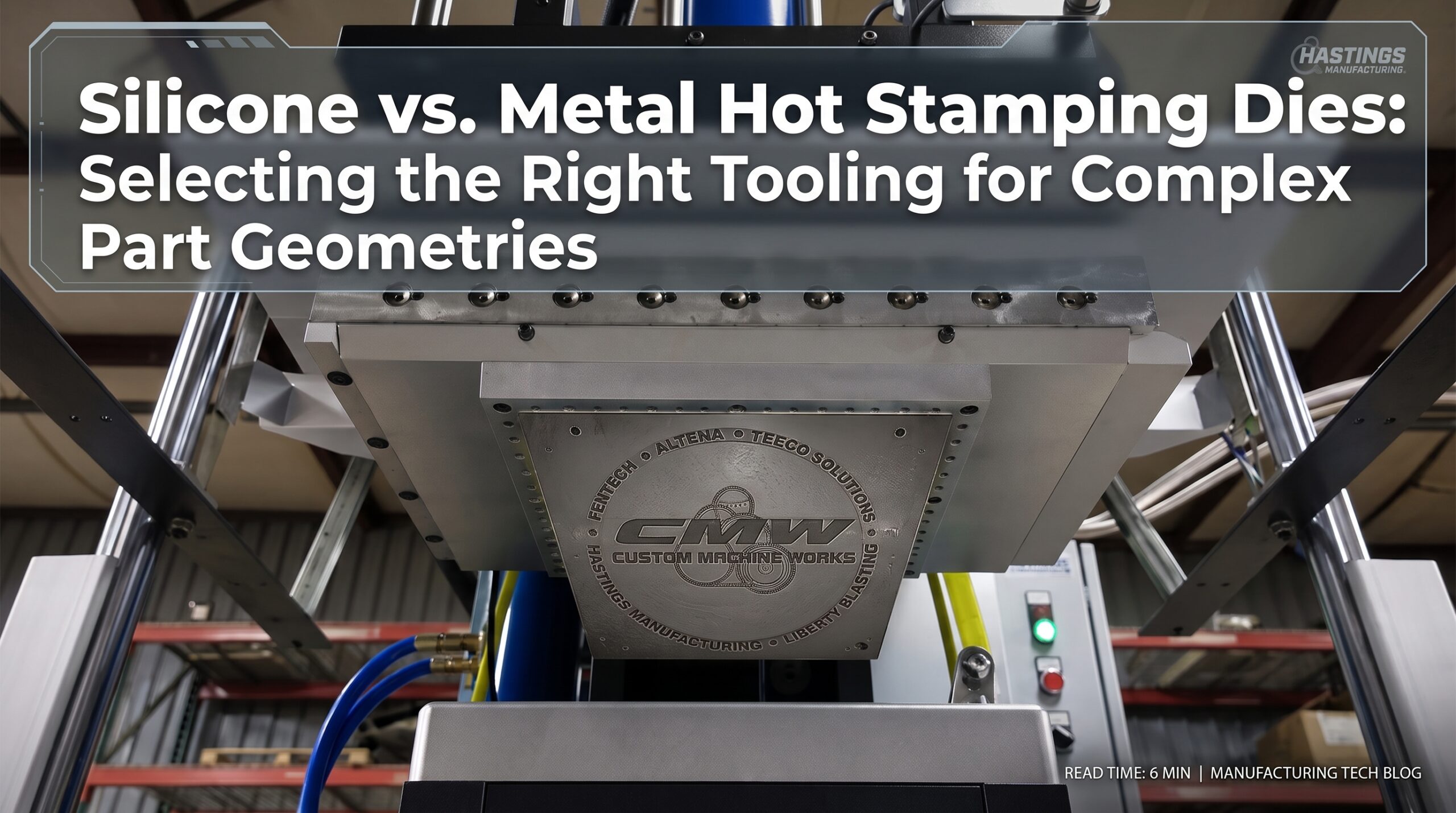
Achieving perfect repeatability in hot stamping and heat transfer decorating is a delicate balance of heat, pressure, and dwell time. However, even the most sophisticated pneumatic or servo-driven press will produce high scrap rates if the tooling is poorly matched to the substrate’s geometry. For manufacturing engineers and procurement teams, selecting the correct die material is the foundational step toward optimizing the production line, improving cost-efficiency, and eliminating wasted material.
When evaluating die configurations, the choice between silicone vs metal hot stamping dies ultimately comes down to part geometry, material rigidity, and thermal recovery requirements.
Analyzing Die Materials: Conformal Yield vs. Rigid Precision
Silicone Rubber Dies: Mastering Complex and Contoured Geometries
Silicone rubber dies are engineered with varying durometers (hardness levels) to conform to slight variations, tapers, or sink marks in molded plastics. When stamping on complex curves, multi-level surfaces, or imperfect radii, a rigid die would leave voids, cold spots, or incomplete foil transfers. Silicone compresses naturally upon impact, ensuring uniform pressure distribution across the entire stamping area.
While the thermal conductivity of silicone rubber is inherently lower than that of metallic alloys, modern thermally conductive silicone formulations compensate for this variance. This allows for efficient heat transfer without scorching delicate thermoplastic substrates.
- Superior Conformability: Flexes to accommodate sink marks, molded-in stresses, and slight dimensional inconsistencies in injection-molded parts.
- Scrap Reduction: Eliminates “dropout” and incomplete prints on contoured automotive and consumer goods.
- Foil Forgiveness: Reduces the risk of foil cutting, bridging, or flashing on sharp radii.
Metal Dies (Brass, Steel, and Magnesium): The Standard for Rigid Precision
Metal dies—whether CNC-machined or chemically etched from brass, steel, or magnesium—are the industry standard for high-volume, perfectly flat, or purely cylindrical applications. They excel in environments where crisp, high-definition foil shearing is the primary requirement. Because metal transfers heat instantly and recovers thermal energy rapidly, it supports the aggressive cycle times demanded by automated workcells.
- Rapid Heat Recovery: Essential for high-speed, continuous stamping without thermal degradation.
- Exceptional Durability: Hardened steel and machined brass tooling can withstand millions of cycles without losing face definition.
- Deep Embossing: The ideal choice for applications requiring simultaneous heat transfer and structural substrate deformation (embossing/debossing).
Quick-Reference Comparison: Silicone vs. Metal Tooling
| Feature | Silicone Rubber Dies | Metal Dies (Brass/Steel/Magnesium) |
| Ideal Part Geometry | Contoured, tapered, stepped, or irregular surfaces | Perfectly flat or perfectly cylindrical |
| Thermal Conductivity | Moderate (requires calibrated dwell times) | High (supports rapid, continuous cycle speeds) |
| Substrate Forgiveness | High (compensates well for part variance) | Low (requires perfect part consistency) |
| Edge Definition | Soft-to-medium | Extremely crisp and sharp |
| Best Application | Cosmetics packaging, curved automotive trim | Appliance panels, rigid badges, high-speed runs |
The Synergy of Part Nesting and Advanced Press Controls
Precision dies cannot function in a vacuum. To maximize the lifespan of your tooling and eliminate scrap, the die must be paired with extremely rigid hot stamping tooling and fixtures.
Furthermore, precision custom part nesting is a critical variable; a poorly nested part will shift or flex under tonnage, negating the benefits of even the highest-quality silicone or metal die. By integrating perfectly contoured, custom-poured or machined nests with the micro-adjustable force and dwell controls of our HP Series presses, manufacturers can achieve absolute repeatability—even on multi-level or fragile parts. The HP Series ensures that the exact tonnage is applied uniformly, allowing the die and the nest to work in perfect harmony.
Maximize Efficiency on Your Next Production Run
Whether you are struggling with high scrap rates on a contoured automotive bezel or setting up a high-volume cosmetics line, Hastings Manufacturing has the engineering expertise to optimize your entire workcell from the ground up.
Stop losing margins to inefficient tooling setups and part variance. Contact our tooling engineering team today to discuss your next application, upgrade your current production lines, or order custom-nested fixtures tailored for absolute precision and zero-defect repeatability.