Built for Accuracy. Designed for Production.

Precision Heat Transfer on Technical Textiles: Controlling Pressure and Dwell Time for Synthetics
September 17, 2026
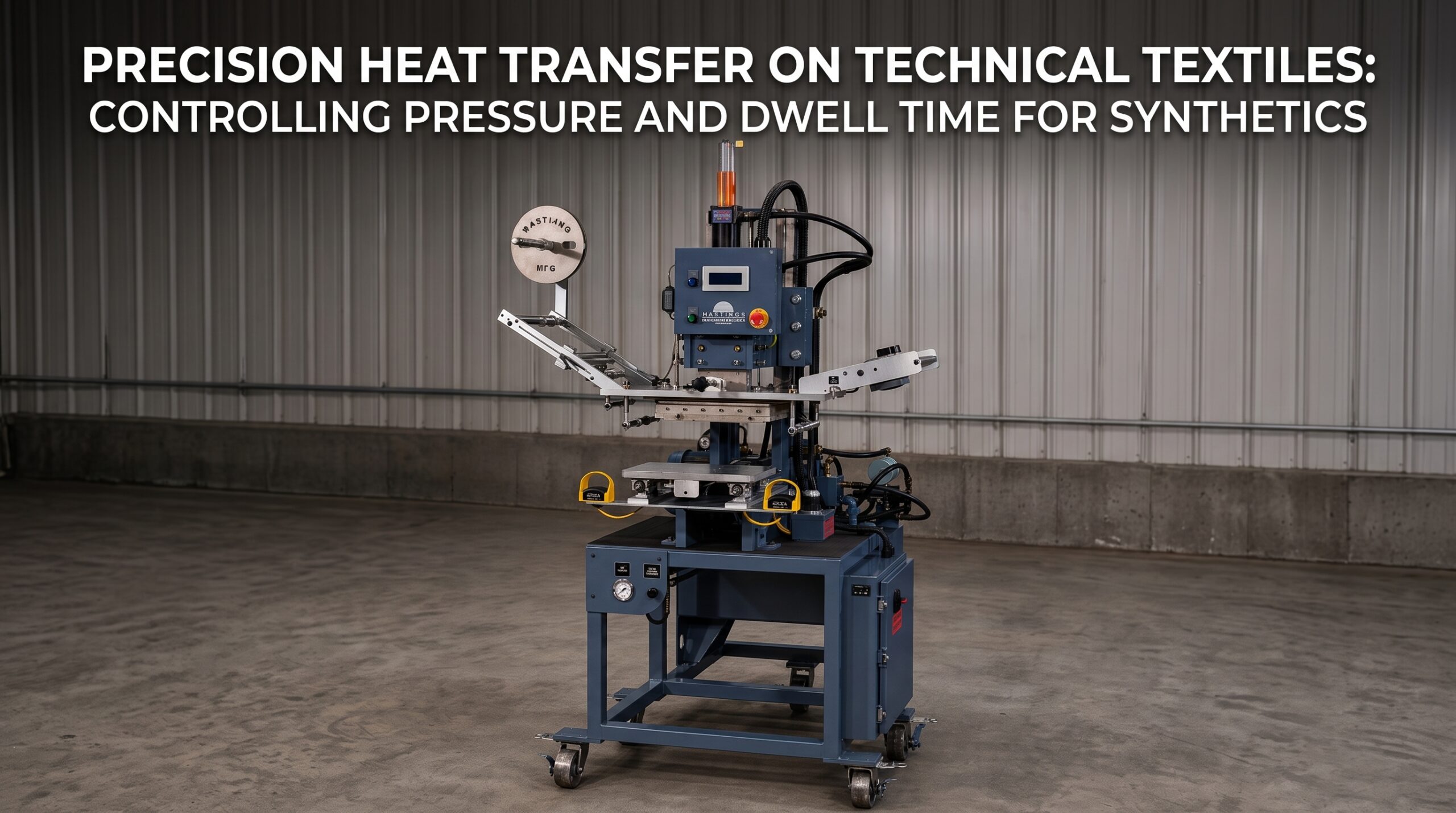
For industries ranging from automotive upholstery to performance sportswear and medical textiles, achieving durable, high-quality finishes on synthetic fabrics is a complex engineering challenge. When executing heat transfer technical textiles applications, operators must navigate the narrow thermal windows of polymers like polyester, nylon, and aramid fibers.
Mastering hot stamping synthetic fabrics requires absolute control over the three core variables of thermal bonding: temperature, dwell time, and pressure. Failing to balance these factors can result in substrate scorching, fiber crushing, or catastrophic adhesion failure.
The Physics of Thermal Bonding on Synthetics
Applying heat transfers, foils, or functional labels to synthetic textiles demands a highly controlled mechanical process. Unlike natural fibers, synthetics are thermoplastic, meaning their molecular structure fundamentally changes when subjected to heat and stress.
Temperature: Avoiding Thermal Degradation
Synthetic fibers are highly susceptible to thermal shrinkage, glazing, or complete melting if exposed to excessive heat. The engineering challenge lies in reaching the activation temperature of the transfer adhesive without compromising the structural integrity of the base textile.
According to research and test methods developed by the American Association of Textile Chemists and Colorists (AATCC), understanding the specific glass transition and melting temperatures of synthetic fibers is critical to preventing thermal degradation during processing. Process engineers must dial in a temperature that safely liquefies the adhesive while keeping the substrate entirely stable.
Dwell Time: Ensuring Substrate Penetration
Dwell time—the exact duration the heated platen remains in contact with the substrate—dictates how thoroughly the melted adhesive penetrates the woven or knitted matrix of the textile. Incorrect textile heat press parameters at this stage can cause significant quality control issues. A dwell time that is too short leads to superficial bonding that will fail during washing or abrasion testing. Conversely, excessive dwell time can cause adhesive strike-through (where the glue bleeds through to the back of the fabric) and exacerbates the risk of fiber distortion.
Pressure: The Critical Role of Uniform Distribution
Even if temperature and dwell time are perfectly calibrated, uneven pressure will result in cold spots, incomplete transfer, and delamination. Technical textiles often feature varying thicknesses, seams, or textured surfaces, demanding a press capable of immense, highly regulated force.
This is where our H Series hydraulic presses excel. Engineered for demanding industrial applications, the H Series utilizes advanced hydraulic systems and heavy-duty, precision-ground heated platens. This design allows the press to deliver perfectly even, sustained pressure across the entire surface area, regardless of minor substrate inconsistencies. By maintaining a uniform pressure profile, the H Series ensures deep adhesive penetration while preventing the localized pressure spikes that cause substrate scorching or fiber crushing.
Validate Your Process with Hastings Manufacturing
Don’t leave your production quality to chance. Validating your precise parameters in a controlled environment is the most cost-effective way to guarantee adhesion and protect your valuable technical textiles.
We invite process engineers to send sample substrates and transfers to our application lab for a free heat transfer feasibility and adhesion test. Our team will determine the optimal temperature, dwell time, and pressure for your specific materials.
Contact us today to schedule your material analysis and discuss a custom automation solution.