Built for Accuracy. Designed for Production.
Integrating Presses into Continuous Lines: Optimizing Cycle Times and Throughput
September 17, 2026
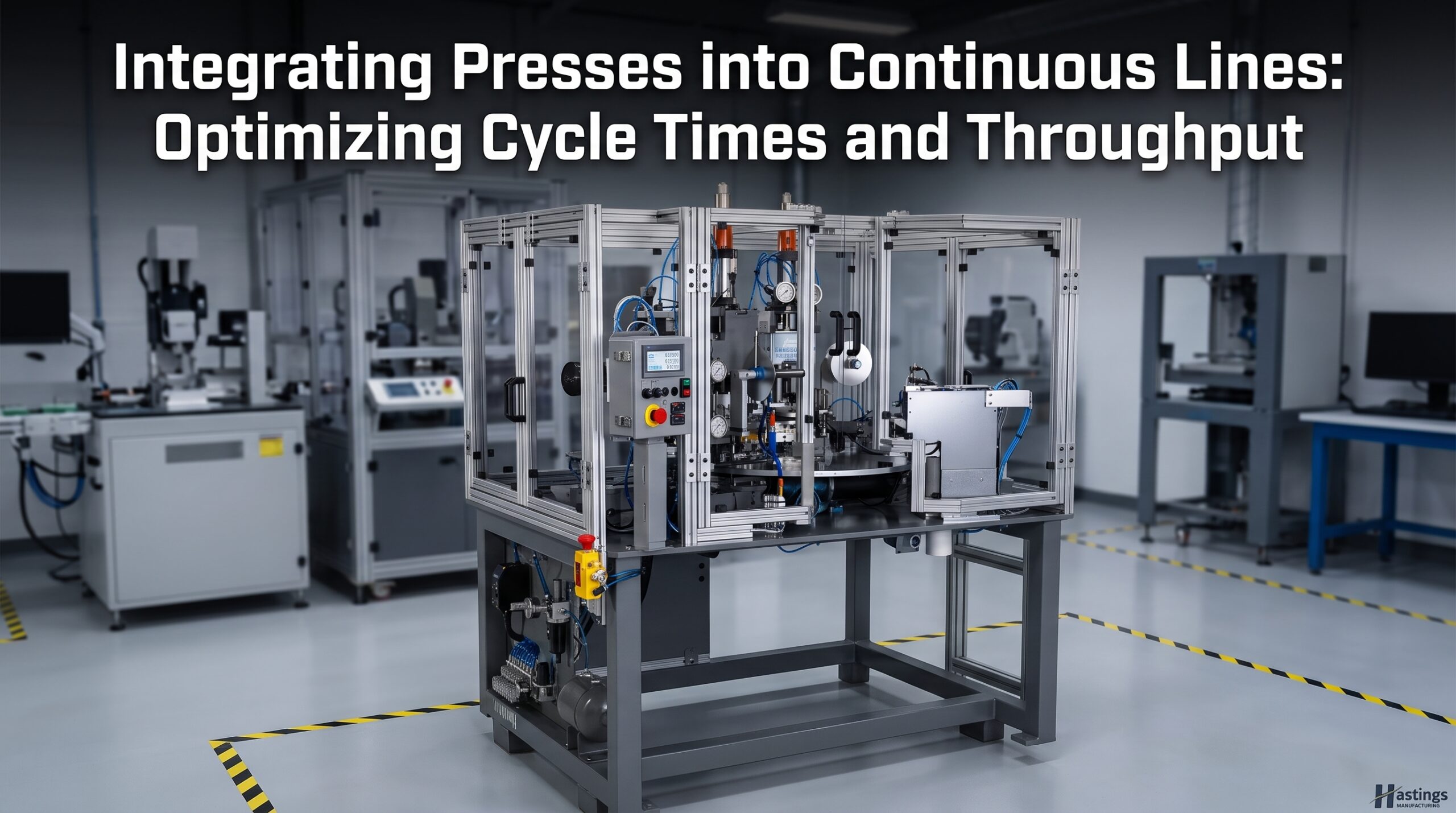
For plant managers and automation engineers, achieving high-throughput manufacturing requires eliminating the silos between operational nodes. While standalone presses offer excellent baseline capabilities, modern high-volume production demands the efficiency of inline hot stamping. By properly synchronizing your pressing equipment with upstream feeding and downstream extraction, you can eliminate work-in-progress (WIP) bottlenecks and drastically reduce cycle times.
Here is a technical guide to mastering the mechanics of syncing press cycles within a fully automated environment.
The Core Elements of Hot Stamping Automation Integration
Transitioning from a standalone workstation to a fully automated cell requires a unified control strategy. Successful hot stamping automation integration relies on precise digital handshakes between the press PLC, material handling systems, and robotic controllers using industrial communication protocols (such as EtherNet/IP or PROFINET).
Upstream Integration: Conveyor Synchronization
The efficiency of any press operation begins with part presentation. Syncing upstream conveyors with the press cycle involves:
- Indexing and Positioning: Utilizing servo-driven indexing conveyors ensures that substrates arrive precisely when the press is in its open, ready state.
- Sensor Integration: Implementing optical or laser sensors verifies part presence and alignment, instantly signaling the press to initiate the stamping cycle. This prevents misprints and protects the tooling from off-center strikes.
- Buffer Management: Designing micro-accumulation zones on the infeed conveyor allows the upstream process to continue running smoothly even during minor press adjustments or foil indexing routines.
Downstream Integration: Robotic Handling
Once the stamping cycle is complete, the part must be cleared immediately to reset the machine state.
- Precision Extraction: Multi-axis robotic arms equipped with custom end-of-arm tooling (EOAT) can grip and extract the decorated part the millisecond the press head retracts.
- Cycle Overlap: Advanced integration allows the robot to enter the press envelope just before the die is fully retracted, shaving critical fractions of a second off every cycle.
- Industry Standardization: By adopting industry-leading robotics and safety standards—such as those championed by the Association for Advancing Automation (A3)—facilities can ensure reliable hand-offs, maintain rigid safety envelopes, and future-proof their production lines.
Engineering a Continuous Production Line Press
To transform a standalone machine into a highly efficient continuous production line press, the equipment must be capable of continuous digital communication. The press cannot simply wait for an operator’s foot pedal; it must function as a responsive, intelligent node within the larger line.
This requires robust thermal management to handle continuous 24/7 cycling without heat degradation, as well as automated foil tensioning and indexing systems that match the speed of the surrounding automation. When these elements are perfectly synced, the press operates seamlessly, driving up Overall Equipment Effectiveness (OEE) and minimizing scrap.
Custom Engineering for Your Facility
Navigating the complexities of cycle synchronization, thermal recovery, and robotic hand-offs often requires a tailored approach. Standard equipment may not natively support the communication protocols or spatial requirements of your specific facility layout.
To bridge this gap, explore our Automation & Integration
capabilities. Hastings engineering teams specialize in retrofitting existing setups and designing bespoke, turnkey systems that integrate flawlessly into your existing architecture.
Ready to eliminate bottlenecks and optimize your cycle times?
Take the next step in production efficiency. Contact our engineering team today to request a custom workflow consultation
and learn how we can integrate seamless automation into your hot stamping processes.