Built for Accuracy. Designed for Production.
Integrating Industry 4.0: Upgrading Press Controls for Data Acquisition and Traceability
September 17, 2026
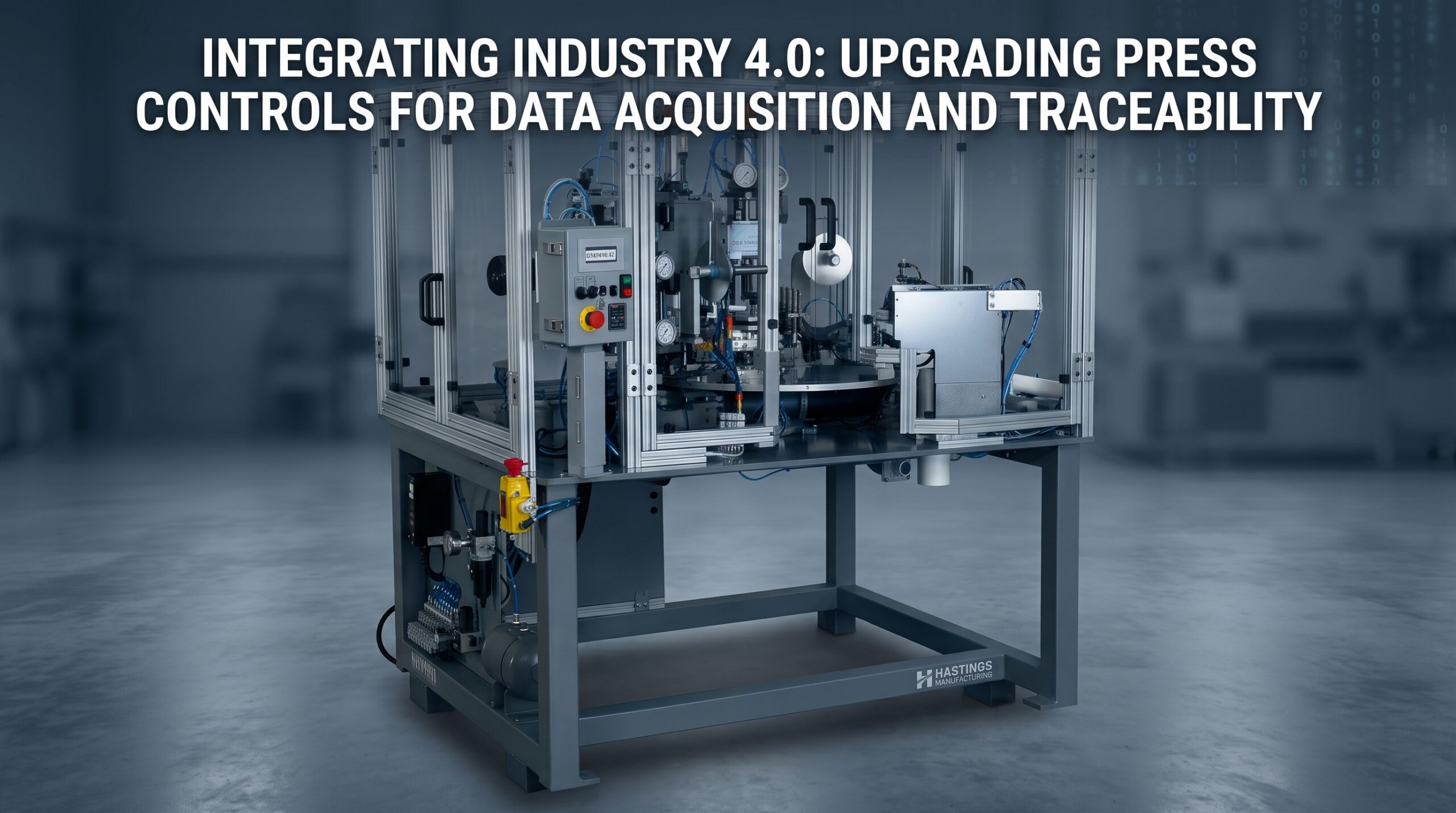
In highly regulated manufacturing sectors—such as medical devices, aerospace, and automotive—mechanical reliability is no longer the sole benchmark of a successful press operation. While heavy-duty industrial presses are built to deliver decades of consistent mechanical force, legacy control systems often lack the “digital brains” required by modern quality standards. Today, risk mitigation requires absolute digital visibility. As production tolerances tighten and regulatory compliance becomes increasingly stringent, the integration of Industry 4.0 press controls is shifting from a mere competitive advantage to a baseline requirement.
Upgrading legacy systems to modern Programmable Logic Controllers (PLCs) and advanced Human-Machine Interfaces (HMIs) bridges the gap between raw mechanical power and intelligent oversight, ensuring every part produced is backed by a verifiable, immutable digital footprint.
The Imperative of Manufacturing Traceability and Granular Data Logging
For manufacturers operating under strict quality assurance frameworks, a single defective part in the field can lead to catastrophic operational failures, regulatory audits, or devastatingly costly recalls. Advanced manufacturing traceability hinges on the ability to record, store, and seamlessly analyze critical process variables for every individual cycle. By executing strategic industrial press PLC upgrades, production facilities can transition from rudimentary pass/fail output monitoring to high-resolution, continuous data logging.
Modern control systems possess the processing power to capture real-time metrics—such as peak applied pressure, thermal fluctuations, stroke speed, and exact dwell times—at millisecond intervals. This granular data can then be plotted into force-distance curves and associated directly with serialized parts or specific batch codes. To ensure this operational data is universally understood, standardized, and securely handled, it is crucial to align with established industrial frameworks. Organizations such as the International Society of Automation (ISA) provide essential standards, such as ISA-95, for enterprise-control system integration. Adhering to these standards ensures that the telemetry harvested directly from the factory floor can be seamlessly contextualized within higher-level Quality Management Systems (QMS).
Eliminating Variability with Advanced Recipe Management
Human error during changeovers or manual adjustments is a leading cause of scrap, rework, and out-of-spec production. When dealing with specialized, highly sensitive applications such as hot stamping data acquisition or precision assembly pressing, even slight deviations in die temperature or application force can fundamentally compromise the structural integrity or aesthetic finish of the component. Modernizing your PLC and HMI architecture introduces sophisticated recipe management capabilities designed to strictly eliminate this inherent variability.
Through a modern, high-definition HMI, manufacturing engineers can program, validate, and lock in optimal parameters for thousands of specific parts. When an operator initiates a shift or a changeover, the press automatically retrieves and adjusts to the pre-validated recipe for pressure, heat zones, and timing. Furthermore, advanced controls allow for role-based access security—such as RFID badge logins—ensuring that only authorized engineering personnel can alter these critical parameters. This not only dramatically reduces setup times but also guarantees that the precise conditions required for regulatory compliance are enforced without manual guesswork or operator intervention.
Seamless Network Integration and Ethernet/IP Connectivity
Acquiring high-fidelity data at the machine level is only half the battle; the true value of an Industry 4.0 integration lies in getting that data off the press and into your Manufacturing Execution System (MES) or Enterprise Resource Planning (ERP) platform. This requires a robust, secure network architecture. Upgraded press controls leverage standard industrial communication protocols, primarily Ethernet/IP, alongside emerging IoT standards like OPC UA and MQTT, to facilitate real-time, bi-directional communication between the shop floor and the top floor.
At Hastings Manufacturing, we specialize in bridging this critical gap between heavy machinery and enterprise software. Through our Automation & Integration hub, our engineering team designs and implements custom HMI screens equipped with vast recipe storage, intuitive diagnostic dashboards, and native Ethernet/IP connectivity. We ensure that your presses are no longer isolated islands of automation, but rather fully integrated, intelligent nodes operating seamlessly within your smart factory ecosystem.
Future-Proof Your Facility
The modernization of legacy industrial presses is a strategic, high-ROI investment in risk mitigation and operational excellence. By capturing high-fidelity operational data, enforcing strict recipe parameters, and integrating seamlessly into enterprise-wide networks, manufacturers can confidently guarantee the traceability and compliance demanded by today’s most rigorous and unforgiving industries.
Do not let outdated controls compromise your quality assurance standards or put your facility at risk of non-compliance. If you are ready to modernize your equipment for total data visibility and precise control, our team is ready to engineer a customized solution.
Contact us today to discuss how our engineering leads can tailor an advanced PLC and HMI upgrade for your specific manufacturing requirements.