Built for Accuracy. Designed for Production.
The Ultimate Engineering Guide to Press Selection: Hydraulic vs. Hydra-Pneumatic vs. Pneumatic
September 29, 2026
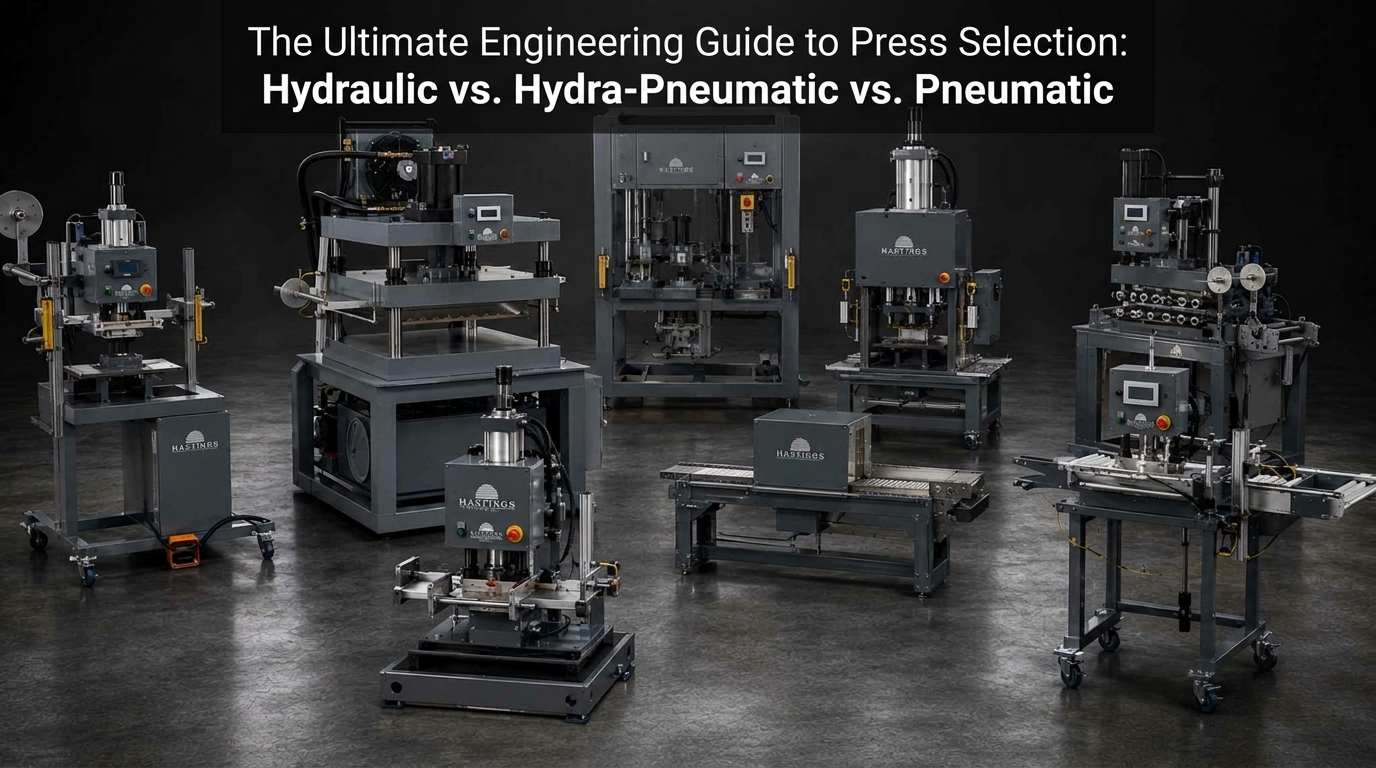
In modern industrial manufacturing, the selection of a press is not merely a procurement checklist item; it is a fundamental engineering decision that dictates your production ceiling, energy consumption baseline, product quality, and long-term maintenance overhead. The power source driving your machinery—whether air, fluid, or a hybrid of both—has cascading effects throughout your entire production line.
At Hastings Manufacturing, our automation and mechanical engineers have spent decades designing, building, and optimizing press systems for industries ranging from aerospace and automotive to medical devices and consumer electronics. We know that there is no “one-size-fits-all” solution. Stamping a high-strength steel automotive bracket requires a vastly different force profile than staking a delicate plastic medical assembly.
This comprehensive technical guide breaks down the underlying physics, mechanical advantages, limitations, and total cost of ownership (TCO) of pneumatic, hydraulic, and hydra-pneumatic presses. By understanding the unique operational characteristics of each, manufacturing engineers and procurement managers can specify the optimal equipment for their facility’s floor.
Section 1: Pneumatic Presses (P Series) — The Speed of Air
Pneumatic presses harness the kinetic energy of compressed air. Using standard shop air (typically supplied at 80 to 100 PSI), these presses channel air through directional control valves into a pneumatic cylinder. The expanding air forces a piston downward, driving the press ram to perform the work.
Operating Principles & Physics
The fundamental physics of a pneumatic press rely on the compressibility of gases (Boyle’s Law). Because air molecules can be rapidly compressed and evacuated, pneumatic cylinders can stroke at incredibly high velocities. The maximum force generated is a direct function of the air pressure multiplied by the surface area of the internal piston (Force = Pressure x Area).
Because plant air pressure is generally capped around 100 PSI for safety and efficiency reasons, scaling a pneumatic press to higher tonnages requires exponentially larger cylinder diameters, which quickly becomes physically impractical. Therefore, pneumatic presses are typically utilized for applications requiring less than 5 tons of force.
Engineering Advantages
- Unmatched Cycle Speeds: Because air evacuates and fills rapidly, pneumatic presses can achieve hundreds of cycles per minute. They are the undisputed champions of high-speed, light-duty manufacturing.
- Cleanroom Compatibility: Pneumatic presses contain no hydraulic fluid. There is zero risk of oil leaks, misting, or fluid contamination, making them ideal for FDA-regulated medical device manufacturing, food processing, and semiconductor cleanrooms.
- Simplicity and Low Upfront Cost: With fewer moving parts, no hydraulic power units (HPUs), and simple valving, pneumatic presses boast the lowest initial capital expenditure.
- Cushioning Effect: The natural compressibility of air provides a slight cushioning effect at the point of impact, which can protect fragile tooling or delicate workpieces from shattering.
Limitations to Consider
- Force Limitations: They max out at relatively low tonnages.
- Air Consumption Costs: While the press itself is inexpensive, creating compressed air is one of the most expensive utilities in a manufacturing plant. Continuous, high-volume cycling can lead to significant compressor energy costs.
- Stroke Control: Precision control over the stroke depth is less exact than hydraulic systems because air is compressible and can “bounce” based on resistance.
Ideal Applications
- High-speed punching, blanking, and shearing of thin gauge materials.
- Light assembly, staking, and crimping.
- Electronics manufacturing and cleanroom assembly cells.
To explore high-speed, clean operation capabilities for your facility, review the exact specifications of the Hastings P Series.
Section 2: Hydraulic Presses (H Series) — Pure Fluid Power
When raw tonnage and absolute control are the primary requirements, hydraulic presses are the undisputed industry standard. These machines utilize an incompressible fluid—typically a specialized hydraulic oil—pumped into a cylinder to generate massive amounts of force.
Operating Principles & Physics
Hydraulic presses operate on the principles of Pascal’s Law, which dictates that pressure applied to a confined, incompressible fluid is transmitted undiminished in all directions. By using a relatively small hydraulic pump to force oil into a large-diameter cylinder, the press multiplies the input force into an enormous output force.
Unlike mechanical presses (which only achieve peak tonnage at bottom dead center), or pneumatic presses (which are limited by plant air PSI), hydraulic systems can be engineered to deliver thousands of tons of force. More importantly, they can deliver full maximum tonnage at any point in the stroke.
Engineering Advantages
- Infinite Stroke and Tonnage Control: A hydraulic press allows engineers to precisely control the ram’s speed, position, and force. You can program the press to approach quickly, slow down just before contacting the workpiece, and apply a specific, sustained tonnage.
- Full Power Anywhere: Full pressing force is available throughout the entire stroke, which is essential for deep drawing operations where constant pressure must be maintained over a long distance.
- Dwell Capabilities: Hydraulic presses can “dwell” (hold pressure) at the bottom of a stroke for an extended period. This is critical in heated applications like composite molding or bonding, where time and temperature under pressure dictate the material’s cure.
- Tooling Protection: Built-in relief valves prevent the press from ever exceeding its maximum rated pressure, virtually eliminating the risk of catastrophic tooling breakage due to overloading.
Limitations to Consider
- Slower Cycle Times: Moving viscous hydraulic fluid requires more time than moving air. While high-speed hydraulics exist, they generally cannot match the rapid-fire cycling of a pneumatic press.
- Maintenance Overhead: Hydraulic systems require stringent maintenance. Oil must be filtered, temperatures must be monitored to prevent fluid degradation, and seals must be periodically replaced.
- Footprint and Heat: Heavy-duty systems require large Hydraulic Power Units (HPUs) taking up valuable floor space, and continuous operation generates heat, often requiring auxiliary water or air chillers.
Ideal Applications
- Deep draw stamping and heavy metal forming.
- Forging of aerospace-grade alloys (e.g., Titanium, Inconel).
- Powder compaction, composite molding, and high-tonnage coining.
For heavy-duty operations requiring maximum force and dwell capabilities, explore the Hastings H Series.
(For deeper reading on the thermodynamics and efficiency of fluid power systems, we highly recommend the technical resources provided by the National Fluid Power Association (NFPA)).
Section 3: Hydra-Pneumatic Presses (HP Series) — The Hybrid Advantage
For decades, manufacturing engineers were forced to compromise: choose the speed and cleanliness of pneumatics, or the raw power of hydraulics. Hydra-pneumatic presses (frequently referred to as air-over-oil presses) were engineered specifically to bridge this gap, offering a hybrid solution that maximizes the benefits of both fluid dynamics and compressed gas.
Operating Principles & Physics
Hydra-pneumatic presses operate using a distinct, highly efficient two-stage stroke system, all powered solely by standard shop air. They do not require a separate electrical hydraulic pump.
- Stage 1: The Rapid Approach. Standard compressed air fills a pneumatic cylinder, driving the ram downward at high speeds. During this stage, the press moves quickly but applies only low force—just enough to reach the workpiece.
- Stage 2: The Power Stroke. Once the tooling contacts the material and meets physical resistance, an internal mechanical sequence is triggered. A pneumatic piston drives into a self-contained, sealed reservoir of hydraulic oil. This acts as an intensifier, multiplying the pressure of the oil and driving the final fraction of an inch (the power stroke) with massive, hydraulic-level force.
Engineering Advantages
- Unparalleled Energy Efficiency: Because shop air is only used to move the ram during the approach, and the high-pressure oil is only engaged for the final millimeters of work, these presses consume up to 70% less compressed air per cycle than a standard pneumatic press of equivalent tonnage.
- Speed Meets Power: They offer the rapid approach speeds of a pneumatic system combined with the high end-force (up to 100 tons in some configurations) of a hydraulic system.
- Clean and Self-Contained: The hydraulic system is entirely internal and sealed. There are no external hoses to leak, no noisy pumps, and no heat generation requiring chillers. They maintain the clean footprint of a pneumatic press.
- Safety and Tooling Life: Because the approach stroke is low-force, if an operator’s hand or an improperly loaded part is in the way, the press will stall before engaging the high-tonnage power stroke, acting as a built-in mechanical safeguard.
Limitations to Consider
- Restricted Power Stroke Length: The high-tonnage portion of the stroke is typically limited to a short distance (often 0.5 to 1.5 inches). If your application requires high force over a long distance (like deep drawing), a hydra-pneumatic press will fail. It is strictly for end-of-stroke work.
- Upfront Cost vs. Pneumatics: They are generally more expensive to purchase initially than a simple pneumatic press, though the energy savings often yield a rapid Return on Investment (ROI).
Ideal Applications
- Clinching, riveting, and staking of sheet metal.
- Piercing, punching, and inserting hardware (e.g., PEM nuts).
- Applications demanding rapid cycle times but high end-force over a short distance.
Discover how hybrid technology can slash your utility costs and boost throughput with the Hastings HP Series.
Section 4: Comparative Analytics & Data-Driven Selection
%%{init: {'theme': 'default', 'flowchart': { 'useMaxWidth': true } } }%%
graph TD
    %% Define Nodes with clean text
    Start(Define Application Requirements)
    Force{Required Tonnage > 5 Tons?}
    Stroke{Full Force Needed Over
 Long Distance? > 2 inches}

    %% Outcomes (Clean text, no HTML tags)
    Hydraulic[Hydraulic H Series]
    HP[Hydra-Pneumatic HP Series]
    Pneumatic[Pneumatic P Series]

    %% Call to Action node
    Automation[Consult Automation & Integration Team]

    %% Define Flow
    Start --> Force

    %% High Force Path
    Force -- Yes --> Stroke
    Stroke -- Yes --> Hydraulic
    Stroke -- No
 (Force only needed at end of stroke) --> HP

    %% Low Force Path (Optimized)
    Force -- No
 (Light assembly, high-speed, clean room) --> Pneumatic

    %% Secondary decision point for complex systems
    Hydraulic --> Automation
    HP --> Automation
    Pneumatic --> Automation

    %% The Correct Native Click Directives for Routing
    click Hydraulic "https://hastingsmfg.net/equipment/h-series-hydraulic/" "View Heavy-Duty H Series"
    click HP "https://hastingsmfg.net/equipment/hp-series-hydra-pneumatic/" "View Energy-Efficient HP Series"
    click Pneumatic "https://hastingsmfg.net/equipment/p-series-pneumatic/" "View High-Speed P Series"
    click Automation "https://hastingsmfg.net/contact/" "Request a Custom Press Quote"

    %% Styling for visual hierarchy
    classDef outcome fill:#e6f3ff,stroke:#005b9f,stroke-width:2px,color:#005b9f,rx:5,ry:5,font-weight:bold;
    classDef cta fill:#fff3e6,stroke:#ff9933,stroke-width:2px,color:#ff9933,rx:5,ry:5,font-weight:bold;

    class Hydraulic,HP,Pneumatic outcome;
    class Automation cta;
To make a truly informed decision, engineering teams must evaluate presses across multiple vectors: Max Force, Cycle Speed, Energy Efficiency, and Maintenance Ease.
Below is an interactive visualization contrasting the relative strengths of the P, H, and HP series presses.
Total Cost of Ownership (TCO) Considerations
When evaluating TCO over a standard 5-to-10-year depreciation cycle, the initial capital expenditure (CapEx) often pales in comparison to operating expenses (OpEx).
- Pneumatic TCO: Low initial CapEx, virtually zero maintenance costs. However, high utility costs due to heavy reliance on plant air compressors.
- Hydraulic TCO: Moderate to high CapEx. High maintenance costs (fluid replacement, filter changes, pump rebuilds). Moderate energy costs, though newer variable-frequency drive (VFD) hydraulic pumps have improved efficiency significantly.
- Hydra-Pneumatic TCO: Moderate CapEx. Exceptionally low OpEx. Because they use a fraction of the air of a standard pneumatic press and require none of the fluid maintenance of a hydraulic press, the HP Series often presents the lowest TCO for short-stroke applications.
| Feature Profile | Pneumatic (P Series) | Hydraulic (H Series) | Hydra-Pneumatic (HP Series) |
| Primary Power Source | Plant Compressed Air | Electrical Pump / Hydraulic Oil | Plant Air with Internal Intensifier |
| Force Delivery | Low to Medium | Very High | High (End of stroke only) |
| Stroke Consistency | Compressible / Variable | Absolute / Rigid Control | Rigid at Power Stroke |
| Environmental Impact | Clean, No Oil | Potential for Leaks, Heat | Clean, Sealed Internal Oil |
| Typical Tonnage Range | 0.5 to 5 Tons | 10 to 5,000+ Tons | 1 to 100 Tons |
Section 5: Materials Science and Press Compatibility
The type of press you specify must align intimately with the metallurgical or chemical properties of the workpiece. You cannot divorce machine design from materials science.
For instance, when stamping high-strength, low-alloy (HSLA) steels or advanced high-strength steels (AHSS) commonly used in lightweighting modern automotive chassis, the material exhibits substantial spring-back. A pneumatic press lacks the rigid force delivery to overcome this yield strength effectively. A hydraulic press, however, can be programmed to dwell at the bottom of the stroke, allowing the crystalline structure of the metal to relax, mitigating spring-back and ensuring dimensional accuracy.
Conversely, when assembling brittle injection-molded polymers, the sudden, unyielding force of a hydraulic system can easily fracture the substrate. The natural compressibility and cushioning effect of a pneumatic press allow the tooling to apply pressure more gently, accommodating slight dimensional variations in the molded parts without causing catastrophic failure.
(For authoritative data on material yield strengths, spring-back characteristics, and forming limits, consult the databases maintained by ASM International).
Section 6: Future-Proofing: Automation, Industry 4.0, and Safety
A press does not operate in a vacuum. It is a single node in a larger, interconnected manufacturing ecosystem. Modern press selection must account for how the machine will communicate with its environment.
At Hastings, we design our presses to seamlessly integrate into automated cells.
- Sensors & IoT: Whether you choose pneumatic or hydraulic, our presses can be outfitted with linear transducers, pressure transducers, and load cells. This provides real-time force-distance curve monitoring, allowing for 100% inline quality control. If a rivet is missing, the load cell detects the discrepancy in resistance and instantly flags the part as scrap.
- Robotic Integration: High-speed pneumatic presses pair perfectly with high-speed SCARA robots for rapid pick-and-place assembly. Heavy-duty hydraulic presses are frequently integrated with robust 6-axis articulated robots for heavy blank loading and scrap removal.
- Safety Standards: Machine guarding is paramount. All press systems must be integrated with light curtains, two-hand anti-tie-down controls, and hard-guarding to comply with stringent OSHA Machine Guarding Standards. Fluid-based systems often require additional safety protocols for high-pressure hose containment and lockout/tagout (LOTO) procedures for both electrical and fluid power isolation.
Integrating these technologies requires a holistic view of the production line. That is where our specialized engineering teams excel. Our Automation & Integration
division works directly with your facility to design custom robotic loading, scrap conveyors, and PLC architectures that communicate seamlessly with your Hastings press.
Conclusion: Making the Right Choice for Your Floor
Selecting between a pneumatic, hydraulic, and hydra-pneumatic press comes down to analyzing the specific geometry of your part, the material yield strength, your required cycle time, and your facility’s utility infrastructure.
- Choose Pneumatic (P Series) for high-speed, light-force assembly in clean environments.
- Choose Hydraulic (H Series) when you require massive tonnage, deep drawing capabilities, and absolute control over the force profile.
- Choose Hydra-Pneumatic (HP Series) when you need high end-force over a short distance, but want to slash your plant’s compressed air costs and maintain rapid cycle times.
Ready to Optimize Your Production?
A highly optimized manufacturing line requires perfectly matched equipment. Do not leave your cycle times, energy costs, and part quality to chance by utilizing an improperly specified press.
Request a Quote Today or speak directly with a Hastings manufacturing engineer. We will conduct a thorough review of your part prints, material specifications, and throughput goals to engineer a custom press and automation solution that drives measurable ROI for your facility.