Built for Accuracy. Designed for Production.

The Engineer’s Guide to Integrating Multi-Head Hot Stamping Systems
September 22, 2026
Modern manufacturing environments operate under immense pressure to increase throughput without compromising precision or aesthetic quality. For components requiring complex, multi-surface decoration or functional heat-staking, multi-head hot stamping systems are the industry standard. However, introducing a multi-head stamper into an automated line is not a plug-and-play operation. It requires a rigorous, systems-level approach to synchronize cycle times, manage thermal dynamics, and ensure seamless material flow from upstream injection molding through to downstream assembly.
This guide provides manufacturing engineers and procurement managers with actionable best practices for integrating multi-head hot stamping machinery into high-volume production lines.
1. The Mechanics of Multi-Head Hot Stamping
Multi-head hot stamping systems deploy multiple heated dies (or silicone rollers) to apply foil, transfer graphics, or stake plastics across several planes of a single part simultaneously. The primary engineering challenge lies in balancing the three critical variables of hot stamping—pressure, temperature, and dwell time—across multiple independent heads while maintaining a single, unified cycle time.
Tonnage and Force Distribution
When striking multiple surfaces simultaneously, the aggregate tonnage required increases exponentially. Insufficient force leads to incomplete foil transfer, while excessive force can warp or crush the substrate.
For high-tonnage requirements, particularly in automotive interior trim or large appliance fascias, robust structural rigidity is paramount to prevent machine deflection. Equipment like the Hastings H Series is engineered specifically for these heavy-duty applications, utilizing reinforced frames and precision-guided pneumatic or hydraulic toggles to ensure equalized force distribution across every stamping head.
Thermal Management
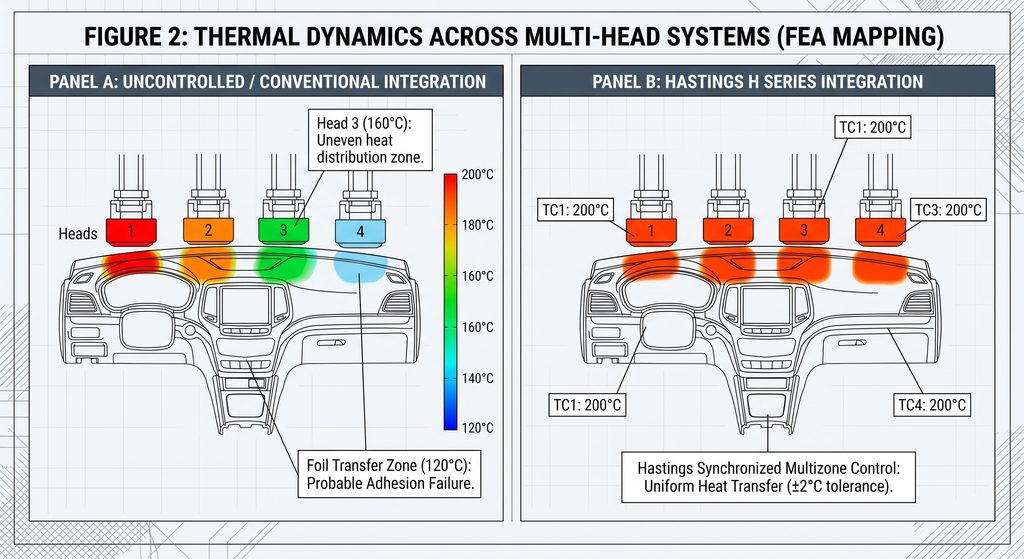
Each stamping head must maintain strict temperature tolerances, often within ±2°C. Integrating a multi-head system requires isolated multizone temperature controllers integrated directly into the central PLC. This allows for dynamic adjustments based on ambient factory temperatures and the residual heat of incoming parts.
2. Synchronizing with Upstream Injection Molding
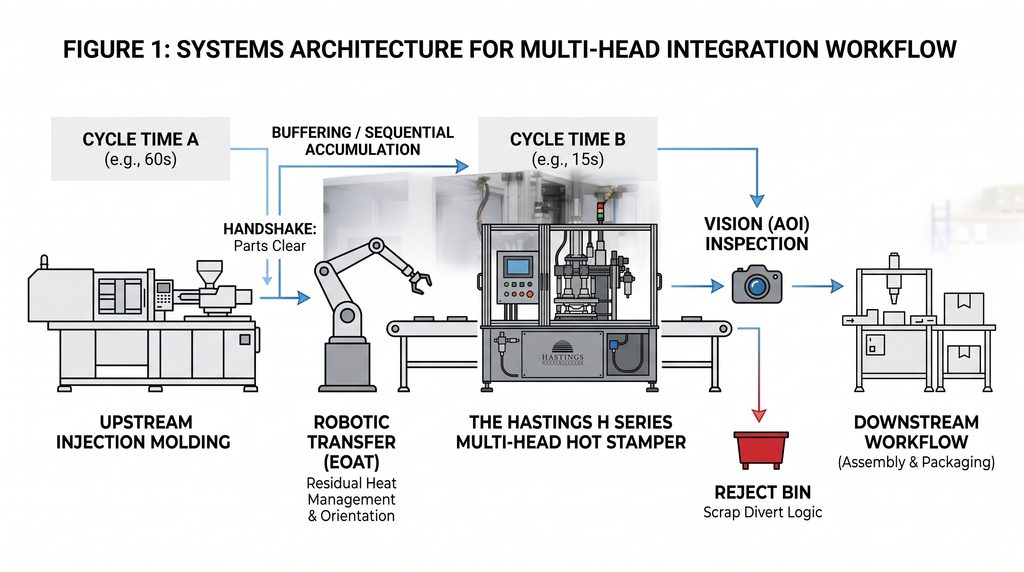
The most critical interface in a highly automated decoration line is the handshake between the injection molding machine (IMM) and the hot stamping cell. When integrated correctly, this synchronization eliminates work-in-progress (WIP) inventory, reduces floor space requirements, and leverages the residual heat of the molded part to improve foil adhesion.
Managing Cycle Time Discrepancies
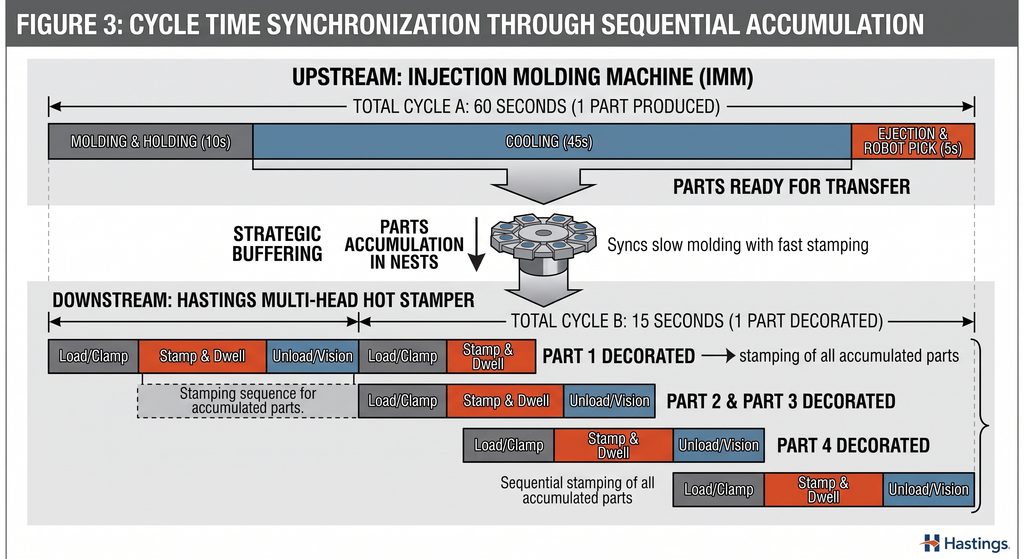
Injection molding cycles are dictated by plastication, injection, holding, and cooling times, often resulting in cycles of 30 to 90 seconds depending on wall thickness. Multi-head hot stamping is typically faster, operating in the 5 to 15-second range.
To bridge this gap without bottlenecking the stamper, engineers must implement strategic buffering.
- Sequential Accumulation: Using a multi-station rotary indexing table allows the stamper to process parts in rapid succession while waiting for the next IMM batch.
- Multi-Cavity Extraction: If the IMM runs a 4-cavity mold, the robotic extractor can place all four parts into a customized nest, allowing a 4-head stamping system to decorate all parts simultaneously, perfectly aligning the macroscopic cycle times of both machines.
Thermal State at Extraction
Stamping a part immediately after ejection from the IMM presents both opportunities and risks. The residual heat in the substrate can reduce the required stamping temperature and dwell time, improving throughput. However, the part is also more susceptible to deformation under stamping pressure. End-of-arm tooling (EOAT) must be designed to support the part geometrically during the transfer, and custom cooling buffers—such as forced-air conveyors—may be required to drop the part’s surface temperature to the optimal glass transition window before it enters the stamping nest.
3. Downstream Assembly and Quality Assurance
Once the part exits the multi-head stamper, it must seamlessly enter the downstream assembly or packaging phase. Integration here focuses on defect detection, scrap diversion, and orientation.
Automated Optical Inspection (AOI)
Because multi-head systems decorate multiple axes simultaneously, human visual inspection is inefficient and prone to error. Integrating high-speed, multi-camera vision systems immediately post-stamping is essential.
- Foil Flake Detection: Vision algorithms can detect micro-tears or un-transferred foil.
- Registration Verification: Cameras confirm that graphics are aligned within millimeter tolerances across all stamped surfaces.
Divert and Reject Logic
The PLC must track the status of each part. If the AOI system flags a defect, the downstream conveyance system must automatically divert the scrapped part without halting the line. Implementing shift-register logic in the PLC ensures that defective parts are tracked accurately as they move down the conveyor, engaging pneumatic diverters at the exact right moment.
4. Robotics and Automation Integration
To fully realize the throughput potential of a multi-head system, robotic part handling is mandatory. Whether utilizing 6-axis articulated robots for complex spatial orientations or high-speed SCARA robots for flat transfers, the integration architecture dictates overall line efficiency.
Handshake Protocols and Cell Logic
The IMM, the robot, and the Hastings stamping machine must communicate via a unified industrial protocol (e.g., Ethernet/IP, PROFINET, or EtherCAT). The handshake logic must account for:
- Mold Open / Parts Clear: The IMM signals the robot to enter.
- Part Present in Nest: Sensors in the stamping nest confirm the part is seated and flush.
- Vacuum/Clamping Engaged: The nest secures the part.
- Clear to Stamp: The robot signals it has cleared the stamping zone.
- Cycle Complete: The stamper signals the downstream handling mechanism.
Developing this logic in-house can be highly resource-intensive. Leveraging dedicated Hastings Automation & Integration services ensures that the mechanical interfacing, custom nesting, and PLC programming are optimized from day one, preventing costly trial-and-error during commissioning.
Navigating Safety Standards
Automated work cells involving heavy-tonnage stampers and fast-moving robotics present significant safety hazards. Integration must strictly adhere to industry safety frameworks. Engineers must design physical perimeter guarding, light curtains, and safety interlocks that comply with the Robotics Industries Association (RIA) R15.06 standard (now harmonized with ISO 10218). Proper risk assessments must dictate the safety-rated stop parameters and collaborative operating spaces, ensuring operator safety without causing nuisance line-trips.
5. Data, Analytics, and Industry Trends
The integration of multi-head hot stamping is no longer just about mechanical alignment; it is about data transparency. As manufacturing shifts toward Industry 4.0, machines must act as data nodes.
According to recent automated manufacturing data reports from the National Institute of Standards and Technology (NIST), facilities that integrate real-time machine monitoring experience a 15-20% reduction in unplanned downtime.
When integrating your stamping system, ensure your PLC captures and exports:
- Heater Band Duty Cycles: Identifying when a heater is drawing excessive current predicts element failure before it halts production.
- Pressure Variance: Tracking micro-fluctuations in air or hydraulic pressure to pinpoint utility supply issues.
- Foil Consumption Rates: Automating alerts for foil roll changes to minimize machine idling.
- OEE (Overall Equipment Effectiveness): Automatically calculating availability, performance, and quality metrics per shift.
By bridging the operational technology (OT) of the stamping cell with the factory’s overarching IT architecture (such as an ERP or MES), plant managers gain unprecedented visibility into the true cost of decoration per unit.
Achieve Seamless Integration with Hastings
Integrating a multi-head hot stamping system into a continuous production loop requires meticulous mechanical, electrical, and thermal engineering. From matching upstream injection cycles to engineering custom nests that withstand high-tonnage strikes without part deflection, the margins for error are razor-thin.
You do not have to tackle this integration alone. The engineering team at Hastings Manufacturing specializes in building, programming, and deploying turnkey decoration cells tailored to your exact production parameters.
Ready to optimize your production line?
Contact our team to discuss your next custom automation solution and request a comprehensive technical quote.