Built for Accuracy. Designed for Production.

Automated Hot Stamping for Rigid Plastics: Optimizing Temperature and Dwell Time in Automotive Interiors
September 16, 2026
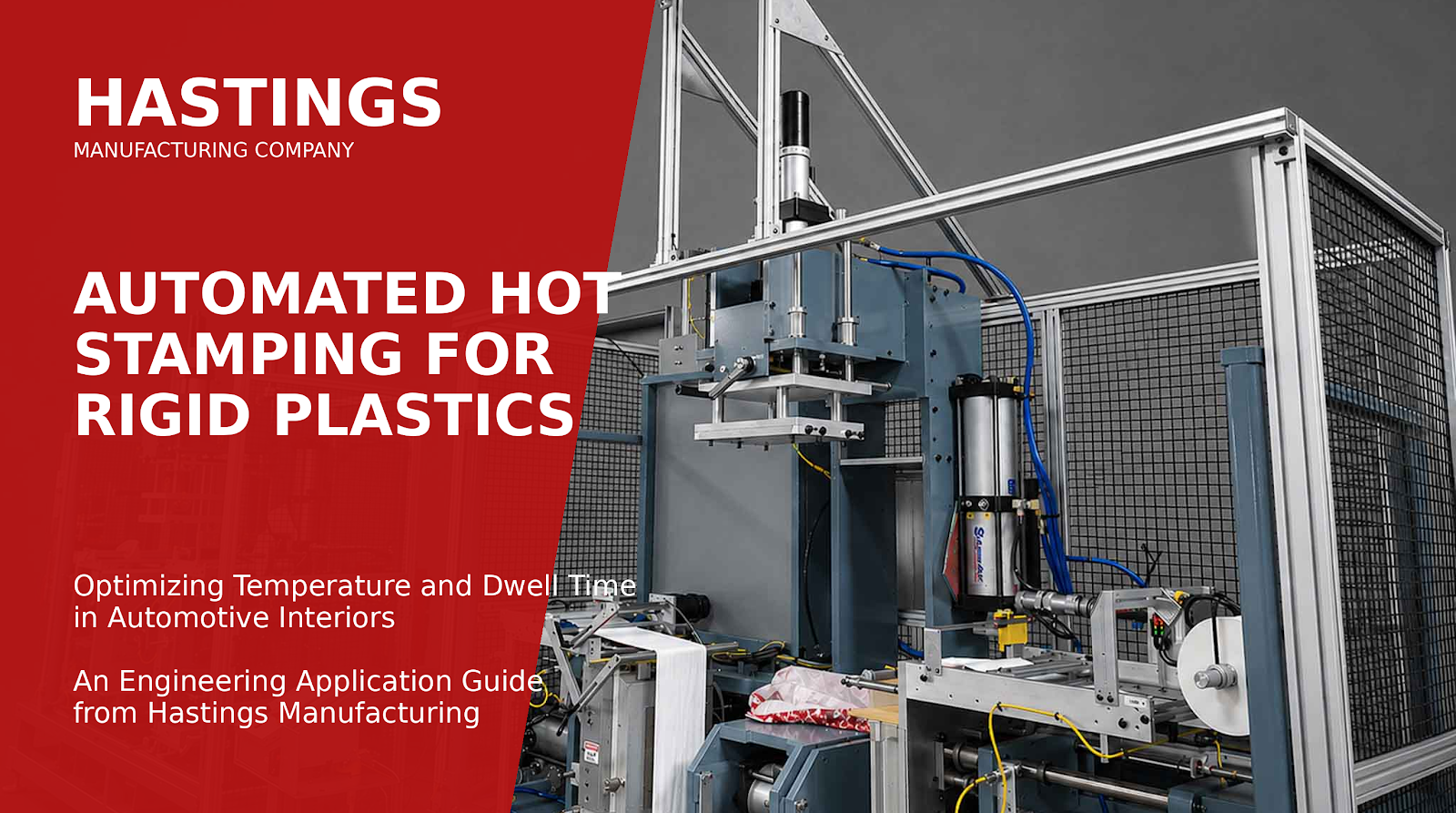
The automotive interior landscape is evolving, with OEMs demanding increasingly sophisticated aesthetics without compromising component durability or production speed. For manufacturers, decorating rigid polymers—such as Acrylonitrile Butadiene Styrene (ABS), Polycarbonate (PC), and Polypropylene (PP)—presents a unique set of thermal and mechanical challenges.
Achieving flawless foil transfer on complex geometries requires a meticulous balance of temperature, pressure, and dwell time. In this application guide, we explore the engineering principles behind hot stamping rigid plastics and how automated systems are setting new standards for efficiency in automotive manufacturing.
The Polymer Mechanics of Automotive Interior Heat Transfer
Successful hot stamping relies on the precise manipulation of thermal energy. Rigid plastics used in automotive interiors possess varying glass transition temperatures (Tg) and thermal conductivities, which directly dictate the required heat transfer parameters.
When working with these materials, engineers must optimize automotive interior heat transfer to ensure the adhesive sizing on the hot stamp foil activates perfectly without causing thermal degradation or warping in the substrate.
- ABS and PC Blends: Known for their dimensional stability and impact resistance, ABS and PC substrates require precise, often slightly higher, die temperatures (typically between 150°C and 190°C, depending on the foil).
- Polypropylene (PP): As a semi-crystalline polymer with lower surface energy, PP often necessitates surface pretreatment (like corona or flame treatment) and highly calibrated dwell times to prevent localized melting or flash while ensuring full foil adhesion.
To ensure parts meet the rigorous quality expectations of OEMs, manufacturers must consistently hit the mark. Adhering to the stringent quality and durability standards outlined by industry authorities like the Automotive Industry Action Group (AIAG) requires highly repeatable finishing processes that manual systems simply cannot guarantee.
Mastering Temperature and Dwell Time Parameters
The relationship between temperature and dwell time is inversely proportional but highly sensitive.
- Dwell Time: This is the exact duration the heated die remains in contact with the foil and substrate. If the dwell time is too short, the foil’s release coat will not melt sufficiently, leading to pitting or incomplete transfers. If it is too long, the heat permeates too deeply into the rigid plastic, causing sink marks or substrate distortion.
- Temperature Control: Multi-zone heating capabilities are critical, especially for large interior components like dashboard trim or center consoles. By utilizing specialized heat blocks with zoned thermal control, engineers can eliminate cold spots across large stamping dies.
Overcoming Throughput Challenges with Custom Part Handling
Perfecting the thermal mechanics is only half the equation; the other half is production throughput. Manual loading and unloading of complex interior trim pieces introduces variance and creates significant cycle bottlenecks, drastically limiting parts-per-hour (PPH) output.
When implementing automated hot stamping ABS and other rigid plastics, the part handling architecture must be as precise as the stamping head itself. This is where Hastings excels. By engineering custom rotary indexing tables, linear conveyors, and pick-and-place robotics, we ensure the substrate is perfectly nested and presented to the stamping die with micrometer accuracy.
Explore our Automation & Integration
capabilities to see how our custom part handling and bespoke nesting fixtures eliminate cycle bottlenecks and maximize equipment OEE (Overall Equipment Effectiveness).
The Hastings Advantage for Procurement and Engineering
For manufacturing engineers, the primary goal is a robust, repeatable process that minimizes scrap. For procurement managers, the focus is on minimizing the total cost of ownership (TCO) while maximizing throughput. Hastings Manufacturing bridges this gap by delivering engineered-to-order hot stamping solutions built for the realities of high-volume automotive production.
From the heavy-duty mechanics of our P-Series presses to fully integrated inline automation, our systems provide the precise thermal management and mechanical stability required for flawless automotive interior finishes.
Ready to Optimize Your Hot Stamping Process?
Stop letting cycle bottlenecks and inconsistent finishes impact your bottom line. Let our engineering team evaluate your specific substrate and part geometry.