Built for Accuracy. Designed for Production.
Scaling Production: When to Transition to Custom Multi-Head Press Systems
September 17, 2026
In modern manufacturing, part designs are becoming increasingly intricate. As automotive, aerospace, and consumer goods industries demand complex, multi-dimensional components, production lines are often pushed to their limits. For procurement managers and manufacturing engineers, relying on single-head presses to process these complex geometries sequentially creates massive bottlenecks.
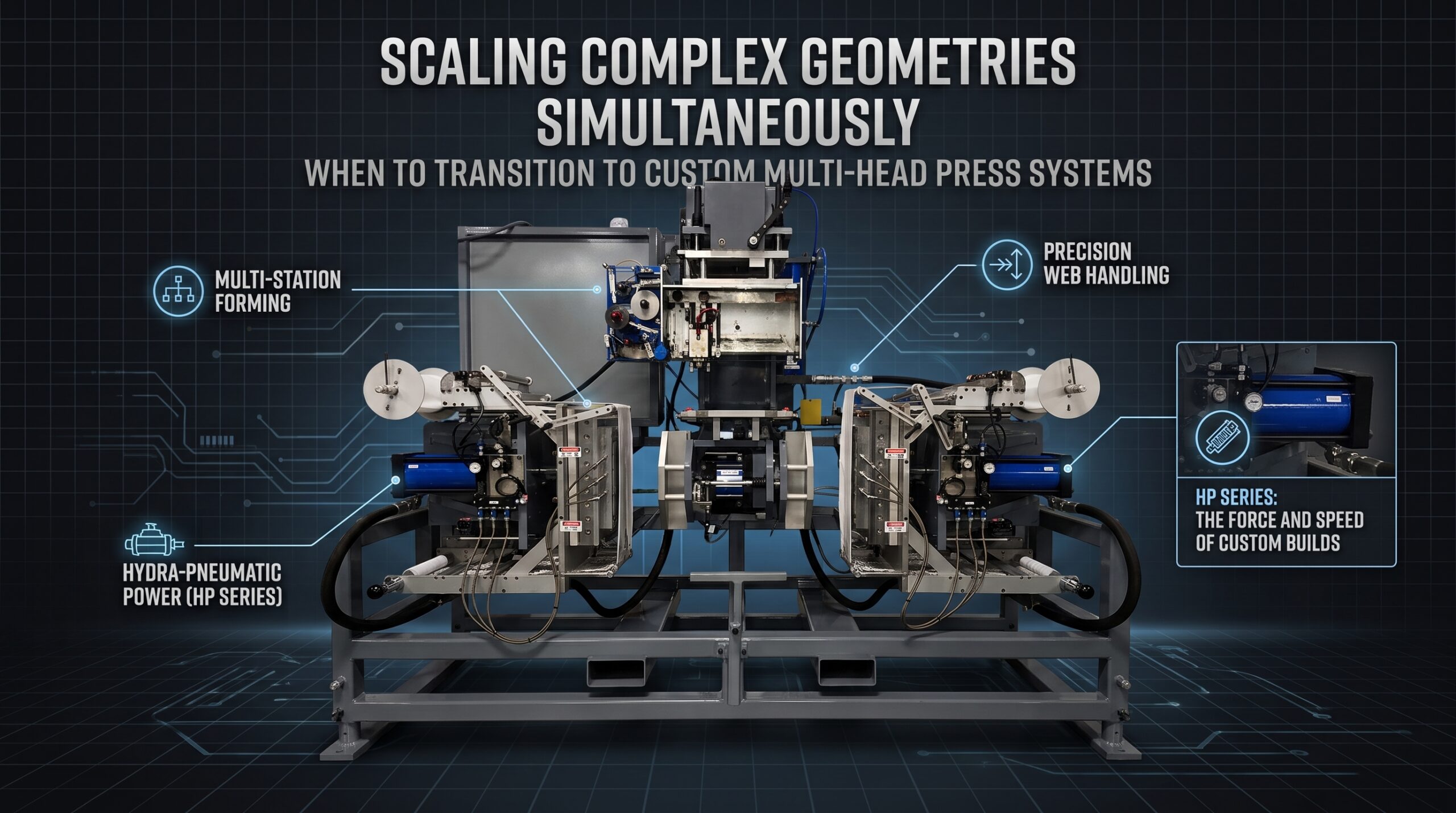
To maintain throughput without compromising quality, operations must eventually transition to a custom multi-head press designed to stamp multiple surfaces in a single cycle. Here is a technical breakdown of the engineering requirements and indicators that it is time to upgrade your scalable manufacturing solutions.
The Engineering Challenge: Multi-Plane Geometries
Processing a 3D component with varying angles and contours—such as automotive fascias or heavily stylized appliance housing—requires precise thermal and pressure management. Sequential stamping of these surfaces increases the risk of part deformation, registration errors, and thermal inconsistency.
By transitioning to a multi-head configuration, engineers can achieve simultaneous multi-plane heat transfer. This ensures that all tooling interfaces make contact with the substrate simultaneously, distributing heat and pressure evenly across the geometry. The result is a drastic reduction in cycle times and a near-elimination of multi-step registration defects.
Powering the Transition: Force, Speed, and Control
Designing a press that can deploy multiple heated heads simultaneously at varying angles requires an immense and highly controlled power source. Traditional pneumatic presses often lack the requisite tonnage for high-speed simultaneous stamping, while fully hydraulic systems can be too slow for high-volume hot stamping applications.
This is where hydra-pneumatic technology bridges the gap. For example, our HP Series hydra-pneumatic presses
provide the ideal foundation for custom multi-head configurations. By utilizing shop air to advance the cylinder and a closed-loop hydraulic system to deliver the final high-pressure stroke, the HP Series delivers the rapid approach speeds of pneumatics alongside the massive, repeatable force of hydraulics. This unique power profile is critical for driving multiple heads into a complex part cleanly and efficiently.
Designing for Scalability
When investing in capital equipment, procurement and engineering teams must ensure the system aligns with long-term growth. According to the Association for Manufacturing Technology (AMT), adopting scalable manufacturing solutions is essential for remaining competitive in high-variance, high-volume markets. A custom-engineered multi-head system acts as a force multiplier, allowing you to multiply your output per square foot of floor space while consolidating labor requirements.
Take the Next Step in Automation
If your facility is struggling with cycle time bottlenecks due to complex part geometries, it is time to evaluate a multi-head automation strategy.
Ready to scale your production? Contact our engineering team today to schedule a scoping call. We will work directly with your procurement and engineering departments to design a custom multi-head equipment build tailored to your exact cycle rate and geometry requirements.
Addressing Your Question: Alignment with Quarterly Marketing Goals
To answer your final question regarding which of these technical concepts aligns best with our current quarterly marketing goals:
The concept of hydra-pneumatic technology driving custom automation (via the HP Series) aligns most aggressively with our pipeline objectives. By focusing on custom multi-head capabilities powered by our proprietary HP systems, we shift the conversation from selling standard capital equipment to providing high-margin, integrated engineering solutions. It speaks directly to the dual pain points of our target audience: engineers looking for technical reliability (multi-plane heat transfer) and procurement managers looking for scalable ROI.