Built for Accuracy. Designed for Production.

Calculating ROI on Automated Part Feeding Systems for Hot Stamping
September 16, 2026
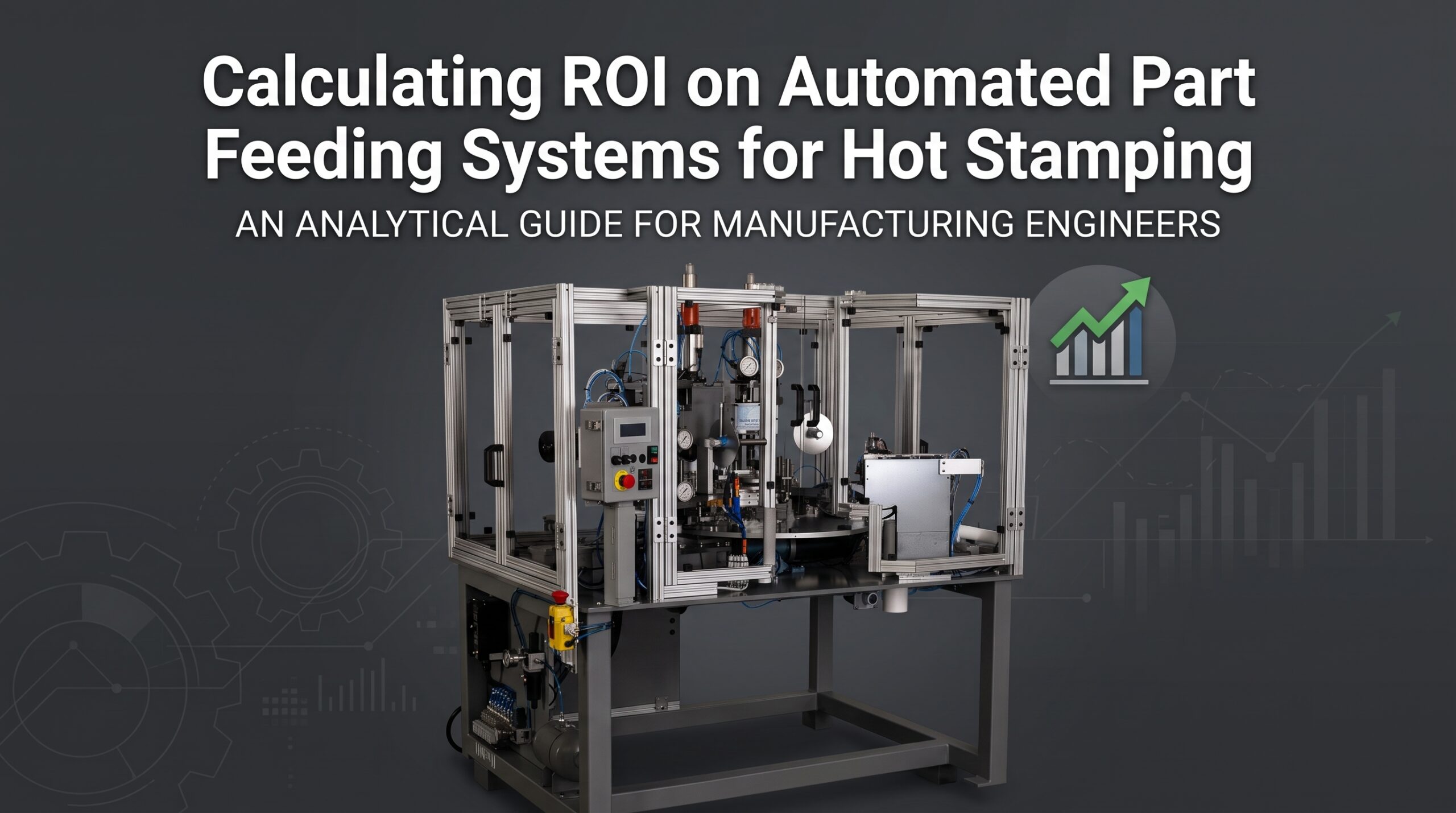
For plant managers and manufacturing engineers overseeing high-volume production, the bottleneck in hot stamping rarely lies within the press itself. More often, it is the manual loading and unloading processes that throttle throughput, introduce safety risks, and inflate scrap rates. Transitioning from manual labor to advanced part feeding systems—such as rotary indexers, pick-and-place robotics, and vibratory bowl feeders—is a critical step toward maximizing operational efficiency and remaining competitive.
However, securing capital expenditure approval requires more than conceptual benefits; it demands a rigorous, data-driven financial justification. Here is an analytical guide on how you can accurately calculate automated hot stamping ROI and determine the true payback period for upgrading your facility’s floor operations.
Identifying the True Costs of Manual Loading
Before calculating the return, you must quantify your existing baseline. Manual part loading inherently introduces cycle time variability. A machine operator might sustain an optimal 10-second cycle for the first hour of a shift, but ergonomic fatigue inevitably pushes that average to 12 or 14 seconds by the end of the day. Furthermore, manual handling increases the risk of part misalignment under the heated die, which directly correlates with higher scrap rates, wasted foil, and inconsistent adhesion quality.
Core Variables in the ROI Equation
To build a compelling business case for high-volume press automation, plant managers should evaluate three primary cost-saving pillars:
1. Labor Reallocation and Cost Reduction
Automation does not merely eliminate labor costs; it reallocates human capital to higher-value tasks like quality assurance, machine maintenance, and process optimization. To calculate your labor savings, multiply the hourly fully burdened labor rate (including benefits, taxes, and overhead) by the number of hours saved per shift, then multiply by the total number of shifts per year.
2. Throughput Velocity and Capacity Gains
Automated feeders operate at consistent, optimized speeds without ergonomic fatigue. If a robotic pick-and-place system reduces your cycle time from 12 seconds to 8 seconds, you have effectively increased throughput by 33%. Calculate the additional revenue generated by this increased capacity, factoring in your profit margins. According to manufacturing efficiency and continuous improvement reports from the Society of Manufacturing Engineers (SME), automating repetitive machine tending tasks can yield double-digit percentage increases in Overall Equipment Effectiveness (OEE).
3. Scrap Reduction and Material Yield
Rotary indexers and automated linear conveyors position parts with micron-level repeatability. This consistency drastically reduces misprints, preventing both wasted substrate material and expensive hot stamping foil. Track your current scrap rate cost per month and compare it against the less than 1% target typical of a properly integrated automated workcell.
The ROI Calculation
Once you have your annual savings quantified, compare it against the Total Cost of Implementation (Capital Equipment + Systems Integration + Operator Training).
ROI = (Net Annual Savings / Total Cost of Implementation) x 100
A well-engineered automated system typically achieves a payback period of 12 to 18 months, after which the net savings directly and permanently bolster the facility’s bottom line.
Engineered Solutions for High-Volume Demands
Not all hot stamping applications can rely on off-the-shelf automation. Complex geometries, delicate substrates, and tight-tolerance multi-color registrations require custom-engineered handling solutions to ensure flawless execution. By integrating bespoke feeding mechanisms directly with the press PLC controls, manufacturers eliminate communication latency between the feeder and the stamping head.
To explore how our engineering team bridges the gap between raw machinery and fully optimized production cells, visit our Automation & Integration page to see our custom handling capabilities.
Take the Next Step in Production Efficiency
Stop letting manual loading limitations dictate your production ceiling. If you are ready to transition to high-volume press automation, you need a precise understanding of how the right equipment will impact your specific floor operations.
Contact our engineering team today for a customized automation throughput analysis, and let us help you build the financial and technical roadmap for your next equipment upgrade.