Built for Accuracy. Designed for Production.

The Engineer’s Guide to Hot Stamping Tonnage Calculation
September 16, 2026
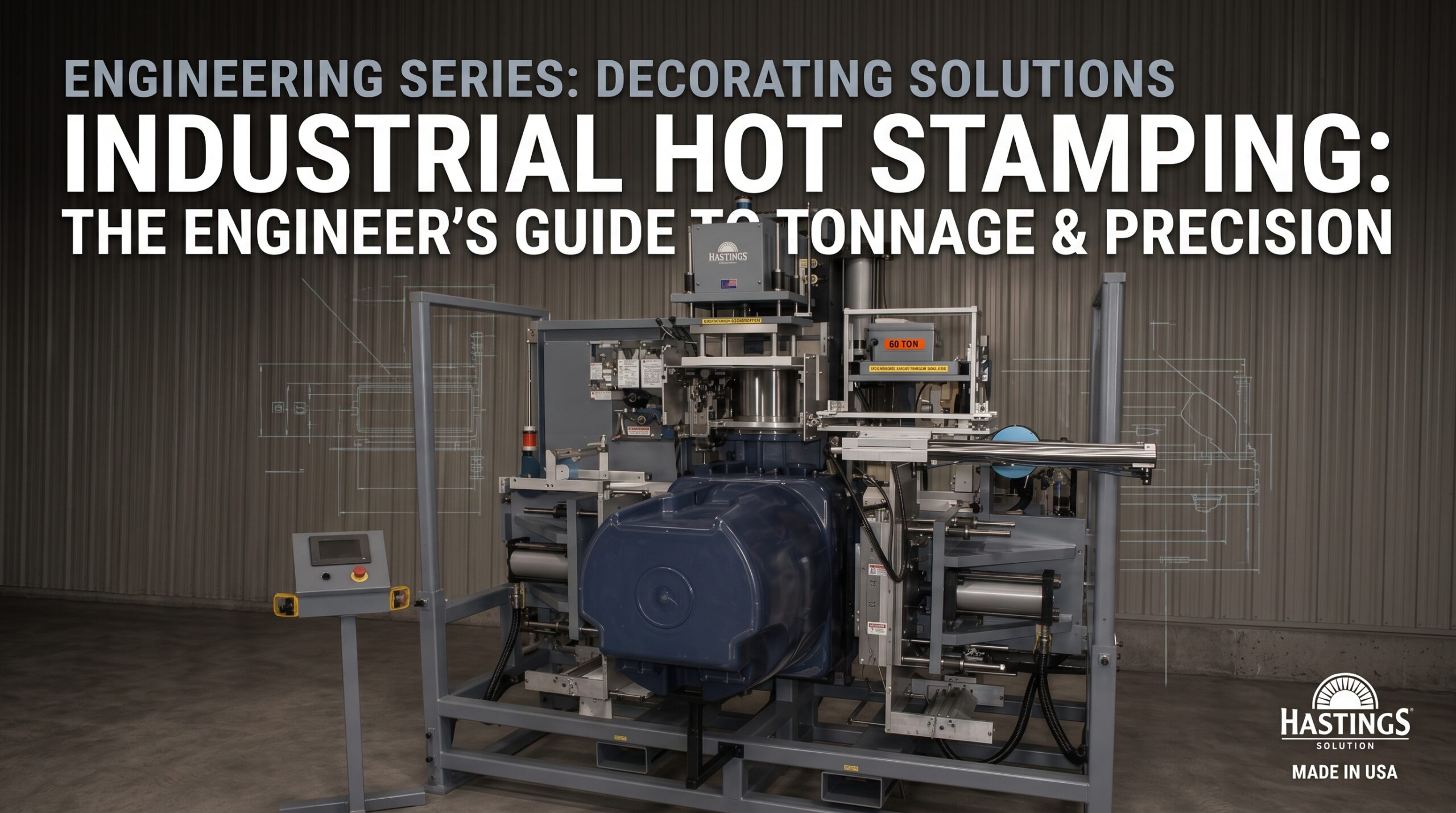
In the realm of industrial decorating, achieving a flawless hot stamp transfer is a balancing act of three critical variables: time, temperature, and pressure. While thermal dynamics and dwell times are frequently optimized on the factory floor, pressure—specifically, the required press tonnage—must be accurately calculated during the initial specification phase.
Specifying an undersized press results in incomplete foil transfers, dropouts, and weak adhesion. Conversely, applying excessive force leads to substrate deformation, flashed foil edges, and premature wear on silicone or magnesium dies. For manufacturing engineers and procurement managers, mastering your hot stamping tonnage calculation is the foundational step in designing a reliable, high-yield production cell.
The Fundamentals of Tonnage Calculation
At its core, calculating the required force for a hot stamping application depends on the total surface area of the decoration and the mechanical properties of the substrate. The standard industry formula is:
Required Tonnage = Total Print Area (sq. in.) × Material Pressure Factor (tons per sq. in.)
1. Determining the Total Print Area
The print area is not simply the overall dimension of the part, but the exact surface area of the die that makes physical contact with the substrate. For solid blocks of color, calculate the geometric area. For text or intricate graphics, engineers must estimate the actual surface area of the raised die geometry, which is often only 30% to 50% of the total bounding box.
2. Accounting for Material Density and Yield Strength
Different polymers require vastly different pressures to achieve proper foil adhesion without distortion. A rigid thermoplastic like Polycarbonate (PC) resists deformation under load and requires a higher pressure factor, whereas a softer polyolefin like Polypropylene (PP) requires a lighter touch to prevent structural crushing.
To determine the exact pressure threshold of your specific polymer blend, engineers must evaluate the material’s yield strength and hardness ratings. We recommend consulting comprehensive material science databases, such as MatWeb’s Polymer Property Data, to verify the compressive yield strength and thermal deflection limits of your chosen substrate before finalizing your tonnage multiplier.
As a general baseline rule:
- Soft Plastics (PE, PP): 0.5 – 1.0 tons per square inch
- Medium Plastics (ABS, Polystyrene): 1.0 – 1.5 tons per square inch
- Hard Plastics (Acrylic, Polycarbonate): 1.5 – 2.0+ tons per square inch
Note: Incorporate a 20% to 25% safety margin into your final calculation to account for minor fluctuations in factory air pressure or variations in part molding.
Press Technologies: Matching Force to Application
Once the required tonnage is calculated, the next critical phase is machine specification. The debate between a pneumatic vs hydraulic press comes down to balancing speed, maintenance, and ultimate force delivery.
Pneumatic Presses
Pneumatic systems utilize compressed factory air to drive the cylinder. They are exceptionally fast, clean, and highly responsive, making them the industry standard for low-to-medium tonnage applications. If your hot stamping tonnage calculation yields a requirement under 3 to 5 tons, a pneumatic system is usually the most cost-effective and efficient choice. For high-speed decorating on smaller surface areas, explore the capabilities of our P Series equipment, which delivers precise, repeatable pressure via rugged pneumatic architecture.
Hydraulic Presses
When stamping large surface areas—such as automotive fascias, large appliance panels, or multi-cavity tooling setups—pneumatic systems fall short. Hydraulic presses use pressurized fluid to generate massive amounts of force smoothly and consistently across a large platen. If your calculation dictates 10, 20, or even 50+ tons of required force, hydraulics are mandatory. To view robust systems engineered for these heavy-duty applications, review our H Series equipment.
Hydra-Pneumatic Presses
For applications that exist in the middle ground—requiring the rapid approach speeds of a pneumatic cylinder but the high-force work stroke of a hydraulic system—hydra-pneumatic press selection is the optimal engineering solution. These systems utilize shop air to rapidly advance the tooling to the part, then engage a self-contained hydraulic intensifier for the final fraction of an inch to deliver high tonnage. This hybrid approach drastically reduces energy consumption and cycle times compared to purely hydraulic systems. For versatile, energy-efficient high-force decorating, discover our HP Series equipment.
Secondary Variables Impacting Tonnage
While surface area and material yield strength form the baseline of your hot stamping tonnage calculation, manufacturing engineers must also account for:
- Tooling Material: Silicone dies flex and conform to slight part variations, requiring slightly more over-travel and sustained pressure than hard metal dies (magnesium or brass).
- Part Support (Nesting): If the part is hollow or lacks internal ribbing, excessive tonnage will cause the walls to collapse. In these cases, custom-machined aluminum or epoxy nesting fixtures must be designed to internally support the substrate, allowing the press to reach optimal tonnage without destroying the part.
Streamline Your Next Decorating Project
Specifying the correct press architecture is a nuanced process that directly impacts your overall equipment effectiveness (OEE) and scrap rates. You do not have to navigate these mechanical trade-offs alone.
Whether you are sizing a standalone machine for a new product line or integrating a multi-head stamping station into an automated robotic cell, our engineering team is ready to assist. Contact Hastings Manufacturing today to discuss custom press sizing, request a quote, or evaluate a turnkey automation solution tailored to your exact application.